
It’s mid July, a quarter of the way through the 21st century, and I hear on the news this morning that a child has died from measles in the UK. I don’t know if this child was vaccinated, or was not vaccinated because of parental concerns, or could not be vaccinated because of auto-immune challenges. But it’s a tragedy that this kind of thing still can happen.
For most of us, catching measles might make us pretty ill, but then, full recovery would follow. For the unfortunate few, it can cause blindness, meningitis and, in extremis, lead to death. Thankfully the vaccine is effective, and measles is, or was, on the way out. It all works on the principle of ‘herd immunity’ – if 95% of the population are vaccinated, the five or so percent who cannot receive the jab are protected because the disease can’t get a foothold in their communities.
But confidence in vaccination is down since the time of Covid. All sorts of factors come into play – disillusion about what was seen as political ‘double standards’ during Covid, mistrust in the vaccines themselves, social media gossip masquerading as fact, and the causal impact these other trends have had on our faith in experts. A significant number of parents and carers won’t get their child vaccinated – they think it does harm, they’ve heard it causes autism (categorically disproved), they think their child can best build immunity by being exposed to the illness, they think it is about personal choice and freedom.
Parental choice is important and we all want the best for our kids – and that best will look different to different people. It might mean living in the country with its fresh air, or in the city with its educational opportunities for example; it might mean giving our children access to a smart phone and all that these mini computers bring, or it might mean denying access until they are older and more discerning. Parental responsibility has never been more complex or challenging. I make no judgements.
But the resurgence in measles speaks to fundamental principles. It underscores in a vivid way the tension between individualism and community coherence. Measles is a kind of parable for our time.
Is the vaccine story also a story of diminishing community? Or just a tale of rising individualism? And can you have the latter without the former? I hear people say ‘but I want my child to build ‘natural’ immunity – ‘that is best’. But some, the most vulnerable, can’t do this. With only 75% being vaccinated in some areas, is individual choice trumping a sense of shared responsibility for others? Is that a fair judgement or not? And is it a coincidence that on the same day we heard about this death from measles, the news also reports about the profound loneliness of children and how some are turning to Chatbot apps for friendship? That is not comfortable reading either.
How do we rebuild community, human community, for our children while honouring individual freedom and choice? What happens when one rubs up too closely to the other and maybe pushes it aside?
I believe that the Christian faith has a huge amount to say on this subject – that, at its best, its deepest, natural and most profound calling is to model and give body to Community while recognising and celebrating the God-given uniqueness of each part – each person. Isn’t that exactly what the Trinity is? Relationship at the very heartbeat of creation?
But first simple human community as a a socio-political ideal – we got so close to understanding it didn’t we? Cast your mind back to Covid days – I think it is extraordinary what people willingly endured for the common good. Children and parents coping with home-learning; young people isolated from and denied the best aspects of university life; doctors and nurses and care workers working long hours in exhausting conditions – all in their way making extraordinary sacrifices to protect and care for the sick and elderly and vulnerable. An epiphany for me was the realisation of how much we depended on those poorly paid but essential workers – the carers, the binmen, the shop and factory workers. We learned something about community and about the disjoin between the value of work and its financial reward. But now we seem to be back to conversations about what kind of immigrant is a ‘good’ immigrant – the skilled and well-paid!
But Community as the divine ideal – let me explain.
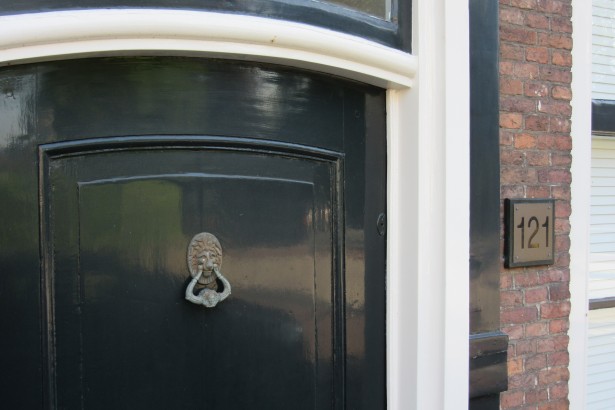
I introduce the vicarage door.
Something else was in the news this week – the state of the parish system in the Church of England. The parish ideal ensures every person within its bounds (and nowhere is outside of a parish) is served by a local church and priest. It is under immense pressure because of the reduction in the number of clergy who, now, have to spread themselves more thinly, cover more churches and more parishes, and so become less available and less a physical and known presence within the community.
But in a society built around networks where we form our primary friendships at work, at the gym, on line and so on, the parish system provides the net for those who fall through – because it is there also for those who have no job, frequent no gym, do not have on-line access. The parish remains a physical space there for all. The Church, rooted in the parish, and the vicarage, is a sign and symbol of utter inclusion. The parish, functioning at its best, embodies this ideal that that no-one is left outside; it is there for those who fall through the other networks. As an institution it exists for those on the outside! Who said that?
In the poem Outwitted by Edwin Markham, we have the idea of people defining us as insiders and outsiders, but love does the opposite. I quote: ‘But love and I had the wit to win: We drew a circle and took him In!”
It was C S Lewis, in his ‘Membership’ essay – published in 1945 – who wrote that our individuality is enhanced in community – and it is the essence of Christianity (I would say all faiths) to have grasped this.
‘The Christian life defends the single personality from the collective, not by isolating him but by giving him the status of an organ in a mystical body’.
In this sentence Lewis seems to be recalling St Paul’s famous description of the Body of Christ as an organic and spiritual whole, needing all its parts to be truly what God has called it to be, and with no part greater or more significant than another even if some appear more ‘front of house’. Again I love The Message interpretation of this and quote verses 12 and 13 of 1 Corinthians, chapter 13 in full (link to 1 Corinthians at end of blog):

‘You can easily enough see how this kind of thing works by looking no further than your own body. Your body has many parts—limbs, organs, cells—but no matter how many parts you can name, you’re still one body. It’s exactly the same with Christ. By means of his one Spirit, we all said good-bye to our partial and piecemeal lives’.
Paul goes on:
‘We each used to independently call our own shots, but then we entered into a large and integrated life in which he has the final say in everything. (This is what we proclaimed in word and action when we were baptized.) Each of us is now a part of his resurrection body, refreshed and sustained at one fountain—his Spirit—where we all come to drink. The old labels we once used to identify ourselves—labels like Jew or Greek, slave or free—are no longer useful. We need something larger, more comprehensive’.
The ‘integrated life’ – a life that not only recognises the intrinsic value of others, regardless of our own needs, but recognises also how our own intrinsic value is wrapped up organically in the intrinsic value of others – we are not made for ourselves alone, and how could we be. We are the creation of the God of the Trinity! At its best, in its worship, in its ministry and its service, and, yes, in its parish model, the Church witnesses to and embodies this ideal dance of individuality and community. There is no longer a tension – no longer a struggle for rights, no longer a competition. What James and John (and probably all the other disciples) struggled to understand when they asked to sit at the right hand of Jesus in heaven, was exactly this. There is no first!
At baptism we are called to be part of the Body of Christ; we become part of that community of the faithful through time and space. Our primary calling therefore is to love and to be loved, to work out what it means to be made in the image of the God of Love, what it means for us and for everyone else. So responding to God in baptism is the first and most important calling. We give the child or the adult a candle lit from the paschal candle and send them out to be a light to the world, wherever in the world God sends them. That’s their calling. To model community.
And to finish with a controversial point which I’ll come back to- if this is so, if we worship within the Community of Love which is the Trinity, salvation cannot be privatised. In a very real sense, my destiny depends upon yours. We are for each other – part of the same Body – and faith is personal but sure, but it can never really be private. That’s for another blog…
1 Corinthians 12:12-27 MSG – You can easily enough see how this kind – Bible Gateway


Thank you for reading – I look forward to hearing your thoughts!