
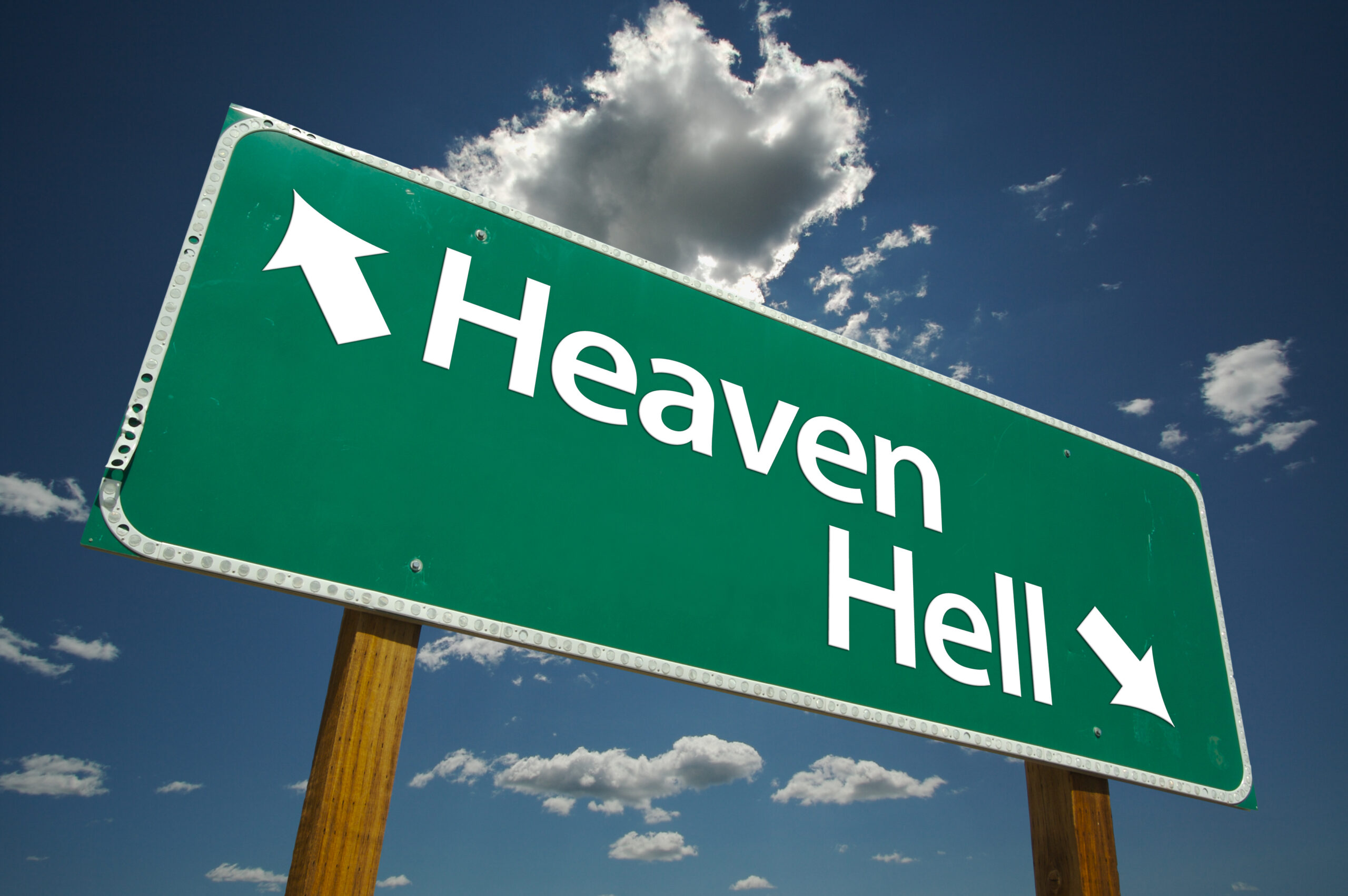
Do you believe in hell?
I don’t. Many other Christians too have rejected the notion, believing it to be a medieval concept designed perhaps to frighten ordinary people into obedience. The notion of hell for me is logically, psychologically and theologically incoherent and makes for terrible evangelism – God is Love, believe that or else! It ‘s awful theology and even worse PR. But it’s not something we speak about very much at all, as if we’re afraid to go there and risk the contradictions it might reveal. That’s a pity.
I take the universalist position, summed up by the title of what for me is the seminal book on this subject, That All Shall Be Saved, by David Bentley Hart, * – that all shall indeed be saved, that all of creation will in the end return to God, the good, the bad, and the ugly.
Now, some popular views on hell might be as follows- many of us won’t believe in any kind of continued existence beyond physical death save as a hook for horror films. Some of us might take the view that hell is as good a way as any to describe this life – with all its wars and injustice and banal suffering. We might even think hell would be a nice (for want of a better word) add-on because it offers us a sense that justice will eventually win the day – and who doesn’t want to believe that to be so? Perhaps, on the other hand, we do think heaven exists, and if that is so, then hell must too, in that ‘philosophy of opposites’ way! You know what I mean – we couldn’t understand joy if there were no suffering; without darkness there could be no light; ergo without hell, heaven means nothing at all!
I’m sure there are many who sit in church on a Sunday who fit into one of the categories above, but I am most interested in those Christians, and there are some, who believe in hell as a condition they hold to as a theological reality.
It would be great to have the resources to do a meaningful audit to find out who believes in hell, and why, but it would I guess be very imprecise based on the variation of understanding of the word as outlined above. But fortunately for me, it’s already been done (though what follows relates to the US only)! It’s one of many and they do vary in their results.
The audit was directed at people of faith and also those with no faith or religious affiliation, and they were asked if they believed in hell ‘as a place where people who have led bad lives, and die without being sorry, are eternally punished’. To be honest even the question makes me flinch at its vagueness – what do we even mean by ‘bad’; how bad? The results indicated an overall increase in belief in hell during this first quarter of the twenty first century, from 2007 until 2024. Perhaps unsurprisingly, the most significant increase was amongst conservative evangelical Christians (that may mean there are more Christians who define themselves thus, rather than a changing of view). Belief in hell had decreased amongst Hindus and Muslims. Belief in heaven far out-ways belief in hell.*
To my mind, hell is very poor theology, and is not borne out by Scripture. We might quote those great passages from Isaiah where the prophet reminds us that God’s ways are not our ways, God’s thoughts are not our thoughts, which is surely so. But the context there, hardly ever quoted, is about showing loving kindness to the wicked. It’s a huge and un-Biblical leap from that to present God’s ways as even more cruel or vindictive than ours, which is what hell suggests to me. It seems we have historically (though less so now) taken the very worst of human desires for vengeance and exclusivity and made it theological. And the idea has done such damage to our attempts at evangelism, and to some vulnerable young Christians. What kind of Good News can argue that if you do not believe, if you do not live by a set of precepts you may not even have heard of, God will somehow in some way reject you?
The cognitive dissonance of holding to such a view of life and death, ‘blaming’ God for it, and then – better still – continuing to function normally in our world as if we did not believe it to be so, is almost impossible to compute. As Bentley Hart puts it, belief in both a loving creator and belief in a place of damnation takes us way beyond Christian paradox and into the realm of pure contradiction where, ‘like the White Queen, (we) learn to believe as many as six impossible things before breakfast’. Further, such a theology takes us too far away from the foundational Christian commandment given to us by Jesus himself – to love God and to love our neighbour as ourselves. Let me quote Bentley-Hart a bit more:
‘An honest interrogation of our consciences, if we allow ourselves to risk it, tells us that this is a contradiction that cannot be conjured away with yet another flourish of specious reasoning and bad dialectics. Can we truly love any person (let alone love that person as ourselves) if we are obliged, as the price and proof of our faith, to contemplate that person assigned to eternal suffering while we ourselves possess unclouded, unconditional, and everlasting happiness. Only a fool would believe it. ……It is a picture that demands of us that we ignore the contradiction altogether. It also demands that we become – at a deep and enduring level – resolutely and complacently cruel.‘
This is not the place to discuss the origins of the idea of hell – that would take a book and it’s sure to have been already written many times over. But it is worth noting here that when Jesus speaks of hell, and he does so a lot, almost exclusively the word ascribed to him in Scripture is Gehenna. Gehenna, though Greek, is from the Hebrew “Ge Hinnom,” meaning the “Valley of Hinnom.” It was a real place somewhere South West of Jerusalem and was closely associated in the Jewish imagination with historical child sacrifice and all manner of cruelty and death. It was, perhaps, the nearest thing to what we might call hell on earth. It was a natural and powerful way to describe life and lives oppressed by the full force of the Roman Empire, the legalism of faith, and the agonising wait for the Messiah promised in the Old Testament. People need images, and Jesus used them to great effect, but we so often forget that the hearts and minds of those who wrote our Scriptures were more comfortable with the resounding depth of metaphor than we are with our often too-clumsy literalism.
Atonement theories come into play here too – they are ways of understanding the role of the life, death, and resurrection of Jesus Christ, the Son of God, in our destiny. There are a few theories but two key ones are the ransom theory of atonement and the penal substitution theory. For those interested there are many books on the topic that will be much more nuanced and in-depth than I can offer here, But, in short, the argument is that human beings were separated from God by sin; God – being a God of Justice – needed atonement for that sin (someone had to pay) but, loving his creation, he sent his Son Jesus to redeem us, to pay the price of that sin, that ‘that all who believe in him might be saved’.
Further, the atonement-theory arguments go, that if all are saved and destined to be with God – my position, and known as universalism – what on earth was the point of Jesus’ sacrifice? Don’t we risk rendering the whole under-pinning of our faith meaningless? I would say, not at all, Dispensing with hell completely from our theological discourse far from renders the sacrifice of Jesus meaningless. If all are saved, then that sacrifice was indeed as perfect as it was intended to be.
People need images, and Jesus used them to great effect, but we so often forget that the hearts and minds of those who wrote our Scriptures were more comfortable with the resounding depth of metaphor than we are with our often too-clumsy literalism.
We were separated from the God of Love by sin, so far separated that we could never hope to find our way home. But God sent Jesus not to die for us in some divine-scales-of-justice way, but to show us how to love, how to find our way back through him and to God. God knew that our human instinct would be to destroy such perfect love as Jesus. And we did. On the Cross. God sent Jesus to die for sure, but not for the reasons we suppose. God simply knew it must happen.
Desmond Tutu once said. ‘We may be surprised at the people we find in heaven. God has a soft spot for sinners. His standards are quite low.” God’s standards are so low that none are left behind. And that is how it should be. When we speak of hell I think we compromise love as revealed in Scripture. Because Love never fails. Ever.
- That All Shall Be Saved: Heaven, Hell and Universal Salvation, by David Bentley-Hart (Yale University Press 2019)
- Audits on belief can be wildly difficult to interpret and they tend to vary widely depending on when they were conducted and by whom. This was just one of many.


Thank you for reading – I look forward to hearing your thoughts!