
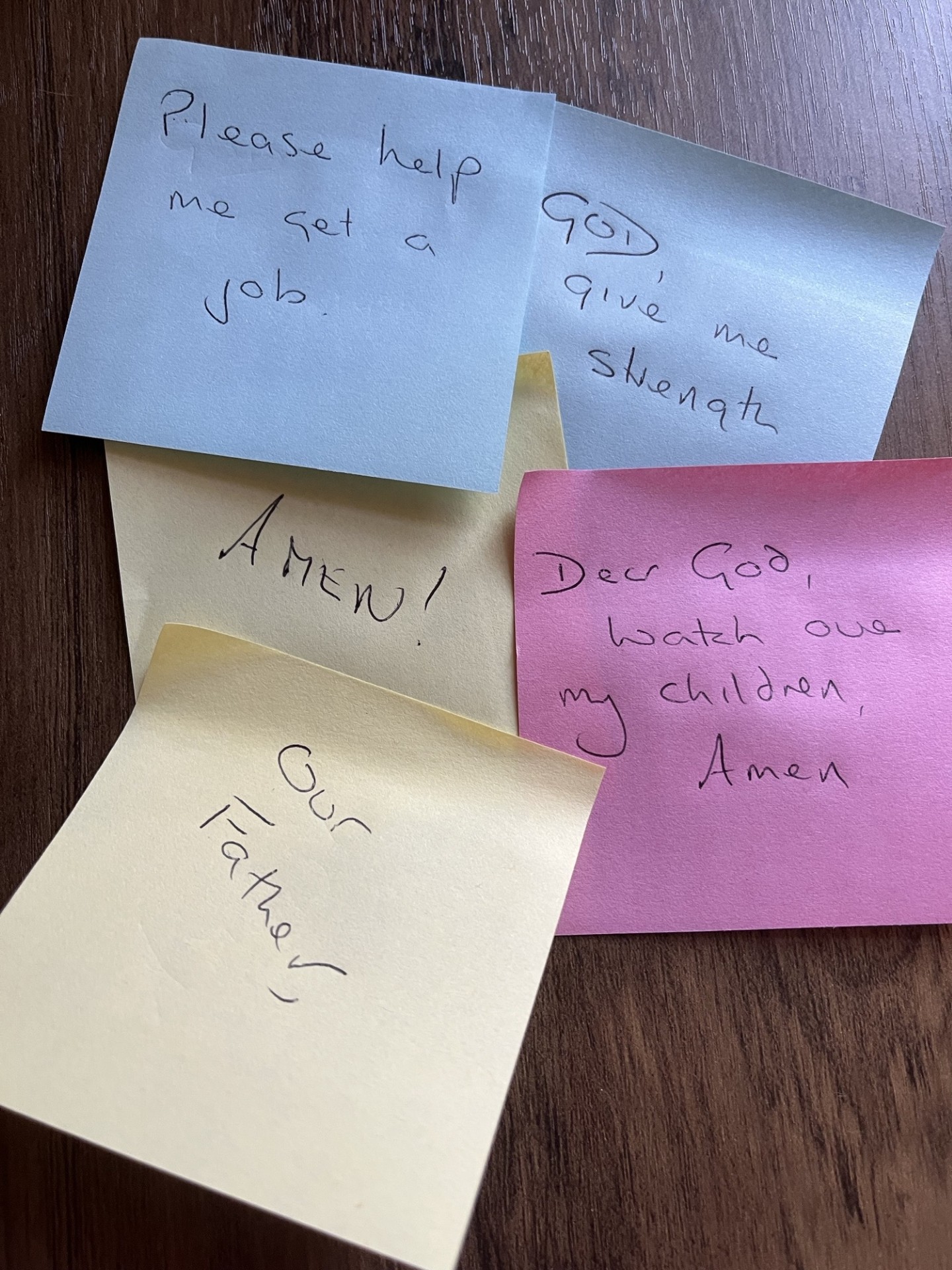
Last week I was engrossed in reading articles about Kemi Badenoch, the leader of the Conservative Party, and her conversation with BBC journalist Amol Rajan. You too may have come across the original interview and the articles that came from it. You can find it on YouTube.
Badenoch talked about lots of things. But the focus of interest for me was on what she said about her loss of faith in the power of prayer and in God. She said she no longer believed in God and described herself as a ‘cultural Christian’.
In the interview, Badenoch told of how as a young person she might pray for a bus to come, or for the right exam results, and so on, – childish prayers is how she herself described them – and they all seemed, to her mind, to be answered. But then in later life, she was to learn about the terrible suffering of Elisabeth Fritzl at the hands of her abusive father, and of how Elisabeth too prayer for years for rescue – seemingly to no avail. Why in her view were her simple prayers answered and yet the more desperate cries to God of Fretzl were not? She said she now no longer believed in God and described herself as a ‘cultural Christian’.
It was such a powerful interview and I’m sure it resonated with many who have skirted with faith and with God and asked why, if God really exists, do some prayers seem to be answered, and yet some do not? There seems to be no rhyme, no reason, and certainly no justice. At its extreme – you pray for that car park space to be available? It’s yours! You pray for world peace or the end of suffering in Gaza? Sorry no can do! How can this be so, we all ask. How can it be that God in his wisdom will answer some prayers and other, much more worthy ones, he will not?
Two things drew me to the story – one, the moving fact that it had not been anything done to Badenoch that had destroyed her faith, but knowing that someone she did not even know personally, but who truly needed her prayers answered, had had those prayers ignored. Two. it caused me to reflect on an ultimate question people have about the nature of prayer – what is it for? how does it ‘work’? what does it mean for prayers to go ‘answered’ or ‘unanswered’? For Badenoch, it was it seems one of those moments when your whole world-view shifts. She told Rajan:
I was praying for all sorts of stupid things and was getting my prayers answered. I was praying for good grades and for the bus to come on time. ‘Why were my prayers answered and not this woman’s? It was like someone blew out a candle.
For those who don’t know the appalling story she refers to, and the nature of Josef Fritzl’s crimes, I will briefly recount it – it will serve to illustrate how Badenoch’s struggle and ultimate disillusion with prayer and with God is a real one, an honest one, and one so many of us experience when we encounter unanswered prayer. It sits into the argument we hear so often – ‘if God exists, why this, or why that?’ and which is at the heart of so much cynicism about faith in a benevolent and all powerful God. We may not have the answer but we should address the question.
The middle aged Elisabeth had been held captive in the family basement in Austria since she was eighteen. Her father, Josef Fritz, had tortured her physically and psychologically, and also raped her repeatedly during 24 long years, during which she bore seven children by him. She was warned she and her children would be electrocuted if they ever tried to escape, and the whole awful tragedy only came to light when her daughter, Kersten, took ill and there was no choice but to take her to hospital for medical attention. Elisabeth had long prayed for help and it took 24 years to come – as Badenoch put it, and who could disagree, “no human being should have had to experience” what Elisabeth endured.
The Bible not surprisingly has an awful lot to say about prayer but underpinning all the deep theology is a simple direction echoed in the words of the famous hymn – ‘take it to the Lord in prayer’. As we would turn to anyone who cared about us, to share our hopes and dreams and fears, so too Scripture tells us, we can share our deepest longings with God. He is listening and he understands the minutiae of our lives, and – if it matters to us, it matters to God.
In Philippians, chapter 4, it’s put this way:
“Do not be anxious about anything, but in every situation, by prayer and petition, with thanksgiving, present your requests to God.”
God is interested in the detail of our lives, and wants to share our worries. When we worry about that bus, which if it doesn’t come soon will make us late for an interview, or if we’re fearful of not being able to park at the hospital, those concerns matter. It’s ok to send up an arrow prayer. It’s ok to pray for that car park space – natural even if you are a pray-er. It may be small in the great scheme of things, but it is not necessarily trivial.
We’ll come back to this. But more examples from Scripture:
In Thessalonians, chapter 5, Paul tells us to ‘pray continually’ – I don’t think this means we should be constantly praying as a spiritual discipline, though if that is our calling, all well and good. I do not know that it is even technically possible – no-one can actually pray 24/7. So what does he mean? Paul seems to me to be saying that life itself should be lived in an attitude of prayer, that our relationship with God should be so easy and natural that we can turn to him anytime. Prayer should be like breathing. It just happens as it needs to, pouring from us unselfconsciously. Like life itself.
And, then we have the Gospel of Matthew, where in chapter 7, we are told by Jesus himself “Ask and it will be given to you; seek and you will find; knock and the door will be opened to you.”. And it challenges us – because when our prayers aren’t answered, we find ourselves doubting ourselves – was our faith not strong enough – or doubting God – why did he not answer me when I prayed for healing, for example?
The answer lies in Jesus’ own prayer life. We know he prayed a lot – he often went aside to pray alone; we know too he prayed without ceasing – that his entire life was lived in an attitude of prayer and union with the Father. We also know of a few prayers he prayed – the most famous one being the Lord’s Prayer. This is so called not just because Jesus taught it to his disciples, but also because it was what he prayed for. It was his prayer. For those who have forgotten or who don’t know the words, here they are:
Our Father, who art in heaven,
hallowed be thy name;
thy kingdom come;
thy will be done;
on earth as it is in heaven.
Give us this day our daily bread.
And forgive us our trespasses,
as we forgive those who trespass against us.
And lead us not into temptation;
but deliver us from evil.
For thine is the kingdom,
the power and the glory,
for ever and ever.
Amen.
Jesus also prayed in the garden of Gethsemane the night before he died that first Good Friday. He prayed that the cup might pass him by – that he might not have to die – but he ended the prayer with these words, ‘not my, but thy will be done’. Not my will, but yours. I often think of all those who have followed Jesus in this prayer of costly surrender – and then died bravely and, in their living and their dying, inspired so many. Think of Dietrich Bonhoeffer, for example, and Maximilian Kolbe.
Because somewhere between Jesus’ prayer in Gethsemane and the Lord’s Prayer we see something of the true essence of prayer. Prayer is not about seeing God as some kind a puppet master who will manipulate the reality we live in, and actually if he did what help would that be? If we prayed that it might not rain on the day of our summer fayre, that sounds reasonable enough, until we remember that somebody’s garden needs the rain! Is our need greater than theirs and is God weighing these needs in the balance? I hope not. And what kind of reality would it lead to – if by prayer we could routinely change the course of natural events, even the nature of cause and effect, then how would we ever live in any meaningful way? The world must operate according to the laws of science and nature, otherwise it would make no sense to us. We could not predict any outcomes and nothing creative would be possible to human beings. There would be no flourishing. God is not a puppet master. And neither is he Santa Claus, who will answer our wildest dreams – however unrealistic those dreams might be, or how opposed to the laws of science and nature he has given us. But still we should ask, and Matthew also reminds us God knows of our needs before we utter a single word.
So what then do the prayers of Jesus teach us? They teach us that prayer is about living and growing within the Being of God; about discovering the will of God and aligning oneself with it; not about changing the world by magic, but about changing us so that we might change the world by courageous action in the service of what is good and loving. Through prayer, we find peace and reassurance as we cast our burdens upon the Lord and trust in His faithfulness to provide for us in every situation however hard that situation might be. And so we pray for courage, for wisdom, for guidance. And, yes, rain if that’s what we need.
Mostly we pray for God to change us. There is nothing wrong with car park prayers – when our relationship with God is natural we share every hope and every concern spontaneously – that is prayer with ceasing – but when we see that car-park prayers as I call them, appear to be answered while children still starve in Gaza; when prayers for a bus to come along appear to be answered while a woman and her children are tortured for a quarter of a century, are answered, it is not surprising that it leans to cynicism about prayer and about God. It should trouble us – but it is rooted in a misunderstanding of what prayer is.
The world must operate according to the laws of science and nature, otherwise it would make no sense to us. We could not predict any outcomes and nothing creative would be possible to human beings. There would be no flourishing. God is not a puppet master.
God is not a puppet master, or Santa Claus, God is Love – its source and its goal – and when prayer becomes the means by which we enter into God’s will and become one with God, our words, our actions, and our very self reveals something of the nature of divine Love. Something of the nature of the Kingdom of God.

Thank you for reading – I look forward to hearing your thoughts!