
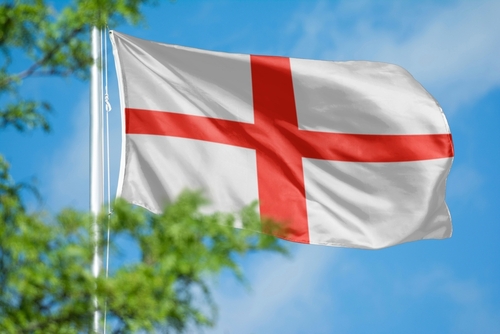
A major topic of conversation at the moment across the media is the appearance of the flag of St George. It is popping up on bridges, on lamp posts, and on small (and sometimes fairly big) roundabouts and no doubt lots of other places too. It’s the sort of thing you only typically see during sporting successes and, much less so, on St George’s day itself. It is a phenomenon of sorts.
And the question being asked is this – does the flag and its appearance represent a surge in good old-fashioned patriotism? Or, is something more sinister, maybe even racist, afoot? Those who argue that this is just patriotism will speak of how other countries – think the US – get to wave their colours everywhere and it’s not a problem. So why can’t we be proud of being English? Why do we get accused of being racist and other countries do not? Others, and I count myself in this group, see nothing wrong with patriotism but wonder at the timing of this enthusiasm for waving the flag just as the debate on immigration becomes more intense and more polarised. Like the old legend that one can no longer wear a poppy (yes we can) or we are compelled to say happy holidays rather than merry Christmas (no, we’re not) there is this feeling that we can’t fly the flag with pride, that our ‘Englishness’ is under attack.
Firstly the flag of St George cannot in and of itself be racist – it’s not human. It is a symbol and has no moral content or direction other than what we invest in it. Symbols can and do change their meaning. For example, remember the old Barclays Bank commercial where we learned – or I did – that in some places it is considered polite to burp at the end of a good meal, in other places, not so? Or that there are cultures where the symbol we have for ok is very acceptable and, in others, it is considered a rude gesture. Think of guns. Are they good or bad? Well. it depends how we use them – to kill or to protect? Moral value is ascribable to human behaviour and not to inanimate objects.

What about the Cross – the ultimate symbol of the Christian faith? Before Jesus Christ and for sometime after, the cross was a symbol of terror and oppression – how Romans kept everyone in their place. It was just two pieces of wood yet came to symbolise hate and death and hopelessness. Through the life, teachings, death and Resurrection of Jesus that same symbol has come to embody for millions and millions of followers throughout history love and life and grace.
Symbols do not have intrinsic meaning; we invest them with meaning. Symbols, including the most profound religious symbols, carry the meaning cultures invest in them. So if the flag of St George were to fly from every lamp post and bridge in Britain, it would not be racist. It would simply be.
The question then is are we flying our colours in such numbers now – at this particular time in our national story – for racist reasons or for healthy patriotic reasons? What symbolism are we investing in it? I don’t claim to answer this question on behalf of the silent majority (the thing about silent majorities is they are silent – we don’t know what they think) but I do believe think it is a genuine desire to express pride in Englishness. And for all sorts of reasons, many who are not racist feel they cannot celebrate for fear of being so labelled. And that is not actually because of some ‘woke’ left desire to oppose patriotism, far from it, but because in recent years the flag, a symbol of honour and inclusion for so long, has had its symbolism hijacked by a vocal minority intent on promoting not patriotism but nationalism, fostering a dislike of others not quite like us. An this is so far removed from the original narrative of St George, it has to be challenged. Maybe the task is to wrestle the meaning back – not to fight those who feel unable to articulate their sense of patriotism, but to ask what is the deepest and truest meaning of the cross, the flag, St George and, yes, those pesky dragons.
George wasn’t a knight – he was a senior officer in the Roman military who was martyred for his Christian faith in the early part of the fourth century. He was a Greek-speaker who was beheaded in Palestine and whose reputation for holiness and heroism inspired many European leaders and kings until he became eventually the patron saint of England and a number of other countries. He never came to England despite the myths and, actually, for over 300 years the Patron Saint of England was an Englishman – Edmund the Martyr, to whom many churches, including St Ed’s in Dartford, is dedicated. But eventually the Cross of St George did become the flag of England. Remember the cry of Shakespeare’s Henry V – ‘cry God for Harry! England, and St. George!’
And what about this dragon he slew? One myth is that he popped over to Libya for example to free the populace from a dragon with a taste for humans. But at the time of writing this piece, no dragon has actually ever been proven to exist. So what does this fierce but mythical beast symbolise?

The slaying of the dragon by St George represents the fight between good and evil. More than anything else, St George embodies what it means to witness to and to risk all to for what is right and good and true and Christ-like – he has inspired so many.
So is raising the flag of St George’ racist? No it is not – in and of itself, absolutely not. And the motives? It’s hard to tell but the timing, when fear of the very small number of refugees (not illegal at all) coming over in small boats is being encouraged, is significant. Patriotism is a good and healthy thing unless it spills over into something more dragon-like – racism and scape-goating. That is where we are now. And it is why the flag is problematic for many.
When I was a kid, I remember hearing about how young girls were getting themselves pregnant and thereby going straight to the top of the social housing list, making life harder for families who were pushed down the list. Putting aside quite how anyone can get themselves pregnant, this too was scapegoating – there was a shortage of housing and we looked around for someone to blame. Then it was young girls, now it is immigrants. They are ‘taking’ this, ‘taking’ that – the are not of course . In truth, if the problem of small boats were resolved tomorrow then the housing shortage, the lack of doctors appointments and school places, and so on, would still exist; gangs who prey on young girls would still exist. Why? Because immigration is not the problem, nor is some perceived attack on Englishness. The problem is scape-goating is so much easier than finding the real solutions to under-funding.
I don’t see the flag as racist at all – I would have flown it myself during the women’s euros if I had one. But that cross it bears always to me represents inclusion and tolerance and welcome – the association of a nation’s story with a saint who fought for Christ and against the dragons of hatred, exclusion, injustice. But I am troubled by the context – it’s clearly an engineered response to refugees (who have no ‘legal’ route) coming in boats and the sense that they are responsible somehow for our legitimate concerns such as housing. They are not. So this surge in flag waving is led by those who want to blame rather than address issues which existed way before all this. The tactic is easy and dangerous – don’t address the problem and why it hasn’t been resolved, but look to see who can we blame for it? Don’t look here, look there! That is disingenuous for sure. I don’t think the flag is racist, I think the timing is.
Thank you for reading – I look forward to hearing your thoughts!