
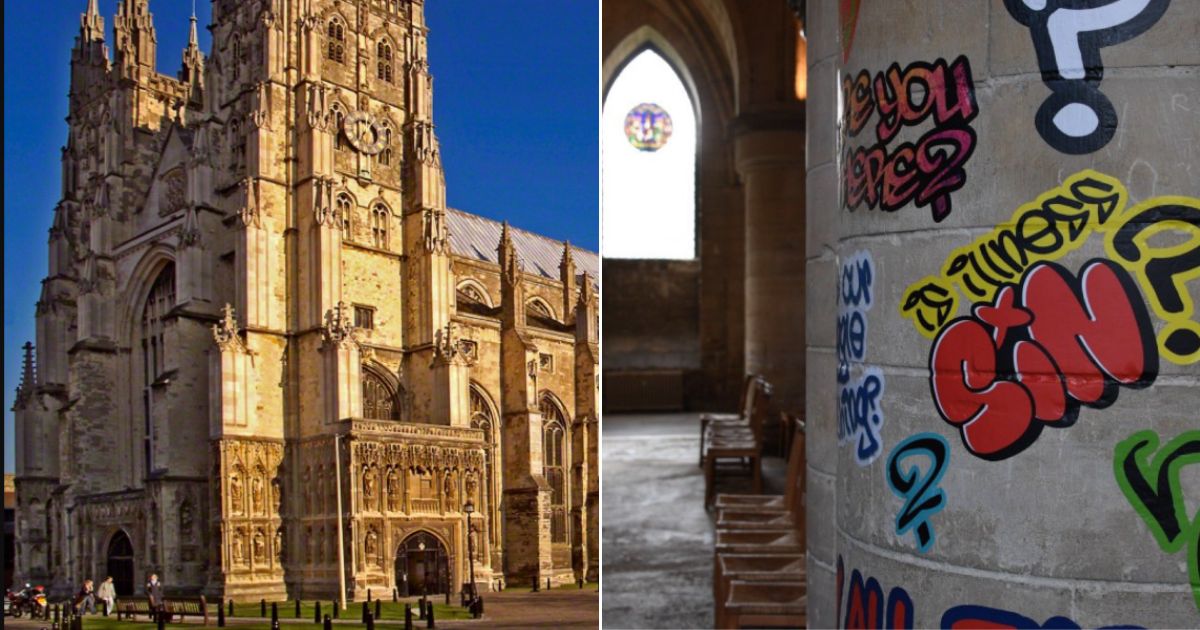
There’s been quite a bit of angst on social media and in the mainstream press due to the graffiti-style artwork that Canterbury Cathedral is hosting at the moment. It’s called ‘Hear Us’ and, though it’s the wrong end of the country for me to visit, I’m quite taken with the idea of modern urban angst meeting the medieval decorum of an ancient cathedral.
It’s been called by some sacrilegious that this might ever be allowed in such a hallowed place. One visitor apparently said it looked like an underground carpark in Peckham! Is it only me hearing the words of Simon and Garfunkel’s Sound of Silence – ‘And the sign said/ “The words of the prophets/ Are written on the subway walls/ And tenement halls”?
I had to smile at the headline covering Peter Hitchin’s piece on this in the Sunday Mail – ‘the writings on the wall for the Church of England’. I see what the editor did there – very clever. But it is temporary artwork after all, and that in itself speaks to the human condition. I reckon it’s truly profound to set the old with the new, the orthodox with the unorthodox, the classical with the modern, and see them come alongside one another across time and space seeking answers to the ultimate questions humans have always asked.
As for sacrilege or blasphemy – I’m sure the Pharisees said something a bit similar when Jesus turned over the tables in the Temple! And lots of other times too! He had a few good answers for those who think holiness is about being kept apart, and clean, and unsullied. But it is something to ponder. What are church buildings for?
What are they for? What are they not for? It’s been said, and often repeated as something of a platitude, that Church is the people and not the building. There’s much truth in that of course – the first followers of Jesus would have met in homes. As their numbers grew, that became harder. So they sought out other places, eventually building specifically for the church community. It’s these buildings that are now pretty much always referred to as the Church. But, really it is the people who come together as the Body of Christ – they are the Church to whom Jesus referred when he told Peter he would build his church upon that particular human rock.
Is it only me hearing the words of Simon and Garfunkel’s Sound of Silence – ‘And the sign said/ “The words of the prophets/ Are written on the subway walls/ And tenement halls”?
So am I saying that the buildings don’t really matter? No I’m really not. I think some people, some Christians, might take that view. They might argue that we expend far too much time and energy and angst on the buildings especially at a time when many do not go to church save for weddings and funerals (and even that, less often that used to be the case) that might be so. Who wants to spend however much money on fixing a leaking roof, which will only leak again, when that could be used to feed the poor? And why not go back to the old days – why not go back to the time when Christians met in each other’s home? Why not get back to our roots? There’s something in that.
House groups are fine as an off-shoot of church but they can never and should never replace the main buildings. House churches are exclusive, because a stranger can never hope to just enter, as they can a church. That is the litmus test for the value of the church as building – not how old are the bricks, or how set-apart in its holiness is the building, or how expensive and shiny the crosses inside, but how open the church is. Church buildings hold the stories of our communities – they are where our parents are buried, where our children were baptised, where we got married. They are the place we could turn to if we fall on hard times or if we need to seek comfort, spiritual or otherwise. Old churches hold the prayers of a thousand generations and we can sometimes, if we listen carefully, hear them. They are a place to go to ask those ultimate questions. They give us space to pray, or, if we prefer, simply to think. The buildings matter because they are there; many seem like they always have been.
And yet a lot of churches are closed for so much of the week. That is the real tragedy – a church that is only open on a Sunday morning or whenever the main act of worship is, is really only open to believers, or the brave few who might dare to go to church for the first time ever when the ‘professionals’ are in. There’s good reason behind keeping them closed – the fear of vandalism, the cost of and inhibiting terms of insurance, the danger of lit candles left unattended. The list goes on. All very sensible, but not so wise.

My favourite church building is Paddlesworth, a tiny church very close to Snodland in Kent and which is now in the care of the Churches Conservation Trust and used only a few times each year. But this special place, medieval in origin and once transformed from church to barn and then back again, is almost always open. It can be – it has nothing to steal, no ancient artefacts, no heating, or lighting, or anything else of material value. Its beauty is that it sits quietly on the same spot and tells the story of grace and faith through generations. And it is almost always open. And that is where its holiness sits – not in who or what it includes or excludes culturally. But in simply being. When it is used for worship, or for a wedding, it is truly a special occasion and an even more special feeling. You get the enduring sense that it holds everything that matters when we talk of the holiness of a church space.
Have you ever read Hard Times by Charles Dickens? In the opening pages the teacher Mr Gradgrind gives us his philosophy of education which leaves no room for the imagination, or for play, none at all – his dream for the young mind is a purely utilitarian gathering of hard facts. ‘Now, what I want is Facts,’ he says. ‘ Teach these boys and girls nothing but Facts. Facts alone are wanted in life. Plant nothing else, and root out everything else.’
Dickens ironically describes Gradgrind’s classroom as a ‘vault’ and his deliberate play on the word brings to mind out attitude to church buildings. A vault can be a place which contains something precious, like a safe, or it can be a place where we simply bury the dead. I love to see art and all contemporary engagement with church buildings, because it means the conversation between past and present and future goes on in the timeless way of God. And because it means the building is open and people are walking through its doors. Holiness, as Jesus so often reminds us, is not about keeping our hands clean or our churches pure and apart from the world, but joining in the mess. The artwork at Canterbury is perfect for our time.


Thank you for reading – I look forward to hearing your thoughts!