
A few weeks back a friend asked me how I chose topics for this blog. It was a really good question and I gave a really bland answer. I said I just write about whatever’s on my mind at the time and, sometimes, just what I’ve been following on YouTube! Nothing deeper or more structured going on than that. The question did though, as good questions always do, make me ponder further and ask myself what if anything I seek to achieve and who I am writing for.
I am not writing primarily for the person who has a mature faith, who has been going to church for years and already knows well enough the parables or teachings or Christian principles I refer to. I assume very little prior knowledge. But I am writing from a particular understanding of those teachings and principles, so hopefully it is still of interest to the more seasoned pilgrim and offers potential for reflection and discussion.
These musings therefore are for anyone keen to reflect on (maybe recalibrate) the basic principles of our faith. They are for those who don’t go to church, and never have, but have an interest in better understanding Christianity. They are for those who used to go to church but have given up; perhaps because of they way we have behaved or because of unresolved questions about, for example, suffering. I am writing also for those sympathetic to the teachings and person of Jesus but who have been put off by the rise of a dogmatic and noisy Christian nationalism which woefully misrepresents the faith of the majority.
If you think that’s only a problem on the other side of the Atlantic pop onto Twitter now and again! I’ve just signed up and it’s proving a real education. There are many, many posts which seek to promote what I would call Christian nationalism. Their arguments tend to follow a specific line – it involves taking all of the Bible literally regardless of the genre of particular books, and quoting with no regard for context. It involves arguing that we are a Christian country (though in what sense is never clearly defined) and so Christian values (still undefined) should hold sway, no matter what. This is not possible while we welcome immigrants who they claim (falsely) seek to supplant and overthrow the ‘dominant’ Christian culture. It is a longing for purity that does, I believe, take us back to the narratives of the 1930s.
The people who post these ‘tweets’ speak much about the Christian faith without saying what it is – it simply becomes a totem for them to gather round, though their real totem is of course the flag not the cross. They seek to agitate any genuine concerns, to create a victim mentality, a sense of identity being lost, and to blame the ‘other’ at every opportunity. They speak mostly in terms of a very muscular kind of Christianity but rarely mention Jesus save in statements such as ‘Christ is King’.
If we are unsure what behaviour is truly Christian, check in with those fruits: love, joy, peace, forbearance, kindness, goodness, faithfulness, gentleness and self-control.
There is little or more truthfully no references to the teachings of Jesus, to his identification with the marginalised and outcast, or his challenge to religious orthodoxy. And God forbid we should be encouraged by them to look deeply into the Christian paradox of the vulnerable and suffering God of the Cross.
Christian nationalism is an oxymoron – when people who claim the title Christian promote hate over love, blind aggression over open-hearted dialogue, and the flag over the cross, it is not unreasonable to feel their agenda is a bleak and distorted evangelism that bears no relationship to the Good News of Jesus Christ.
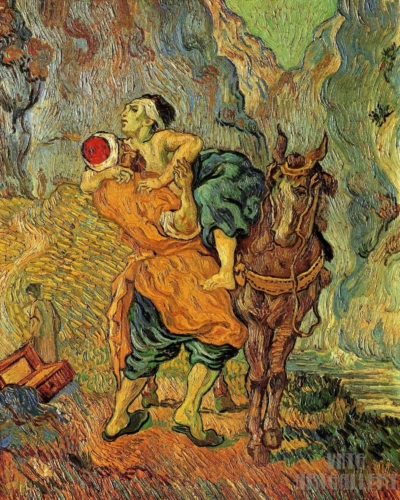
Which brings me to a parable that so many of us know at some level – The Good Samaritan, told in the Gospel of Luke. We may have learned it at school, or in church, or just have imbibed it culturally. We all certainly know what the phrase a ‘good Samaritan’ means – someone who comes to the aid of someone else, even or most especially a stranger. We are also familiar with the charity, the Samaritans, who are there to help anyone in crisis – a good Samaritan at the end of a phone, maintaining all levels of confidentiality.
So far, so good – but maybe the original story has been sanitised by cultural usage, pulled away from its roots, and lost its utterly revolutionary import.
Let’s revisit the parable as told by Jesus: a man who is perhaps not as clever as he thinks he is tries to catch Jesus out in a debate about the workings out of Mosaic law. The man, a lawyer, wants to know how to inherit eternal life – and Jesus says, you know what to do, follow the Law! So the man recites the Law ‘Love the Lord your God with all your heart and with all your soul and with all your strength and with all your mind and love your neighbour as yourself.’
There you go Jesus, you know what to do without having to ask me.
But this man wants to trip Jesus up, maybe get him to say something critical of the law of Moses and so undermine his teachings and turn the crowd against him. But who’s my neighbour, he says, hoping the devil might be in the detail.
And so Jesus tells the story of The Good Samaritan: a Jewish man is beaten, robbed and left for dead. Two Jewish religious leaders see him lying there, and you might think they would come to his aid – but they don’t. They hurry on by for reasons that are not made clear. Then this badly beaten man’s worst enemy, a Samaritan, comes by. You might think he would finish the job, and kill the mugging victim. But no, the Samaritan sees his enemy in distress, and he stops (keep in mind the robbers might still be around and he is putting himself in real jeopardy); he helps him, puts him onto his donkey, takes him to an inn where he will be cared for, and offers to return later and pay for that care. All this for a stranger and a very real enemy.
That’s the story. And so Jesus says to the lawyer – who of the three was the neighbour to the robbed man? The lawyer says the man who came to his aid – there you go then, says Jesus, ‘go and do likewise’. In other words, your neighbour is not only the one who looks like you and lives like you; your neighbour is not just the one who shares your beliefs or is on ‘your side’. Your neighbour may be the one the loudest voices say is your worst enemy, but they are still your neighbour. Love your neighbour as you love yourself is to love any and every human being. I have never, ever heard a Christian nationalist refer to Jesus’ teaching of The Good Samaritan – and I don’t wonder why!
Martin Luther King famously spoke often of this parable and spoke powerfully of its focus on and the need for ‘a dangerous unselfishness’ in the United States. He pondered why the priest and levite didn’t stop to when surely you could have expected them to – maybe they were scared, maybe they thought he was faking and it was a trap, maybe they didn’t want to break the strict rules of purity laid on them. Who knows? Whatever happened, they found reasons not to help. But we must take risks he argued.

They didn’t stop to help him. And finally a man of another race came by. He got down from his beast, decided not to be compassionate by proxy. But he got down with him, administered first aid, and helped the man in need. Jesus ended up saying, this was the good man, this was the great man, because he had the capacity to project the “I” into the “thou,” and to be concerned about his brother.
Martin Luther King Jr
In this context I would love to write about the Jo Cox Foundation, founded in November 2023 following her murder. Sadly there isn’t the space but the charity argues that “a kinder, fairer and more connected world is possible” because “we have more in common than that which divides us”. Nothing could be more true, nor could there be a braver thing to argue for in response to her tragic death and continued and deliberate attempts to divide and cause hurt.
Christian values have nothing to do with Christian nationalism, nothing at all. I know that because we are told quite categorically by Paul in Galatians what those values are. They are the fruits of the Spirit. So, if we are unsure what behaviour is truly Christian, check in with those fruits: love, joy, peace, forbearance, kindness, goodness, faithfulness, gentleness and self-control.
Which of these abound in Christian nationalism? None And yet, ‘by their fruits you shall know them’.
Luke 10:25-37 MSG – Defining “Neighbour” – Just then a – Bible Gateway
Thank you for reading – I look forward to hearing your thoughts!