

Scripture Through Art
“And he has filled him with the Spirit of God, with skill, with intelligence, with knowledge, and with all craftsmanship.” Exodus 35: 31-32
One of my absolutely favourite passages in the Bible is John 1: 1-14, known as The Prologue and most often heard at Christmas, perhaps at Midnight Mass and certainly during the service of Nine Lessons and carols. These beautiful words (which feel far more like poetry than prose) begin with the following lines – ‘In the Beginning was the Word, and the Word was with God, and the Word was God’ – the Word here refers to Jesus and the claim is that Jesus is somehow the Word of God – the perfect expression of God if you will.
John’s Gospel is rooted in Greek philosophy and the word ‘Word’ is best translated from the Greek ‘Logos’ or ‘Reason’. In short, the claim is that in the person of Jesus Christ, God wrote Godself into this world. In one real sense therefore, God is no longer a mystery – because we can know the nature of God through the life, teachings, death and Resurrection of Jesus. Jesus is God written into our world – we look at Jesus and we see the nature of God, and that nature is pure Love. There is much still about God that is and should remain a mystery – because God is God and we are not – but in what most matters, I would say, Jesus says all we need to know about ourselves, about our world, and about our place in it. And, yes, about God too.
The other key passage where we reflect on God and what it means to be made in God’s image comes with Genesis, the first book of the Bible, and its creation stories. In Genesis we are told that we are made in the image of God. That doesn’t mean God has curly hair or brown eyes, or indeed that God is male. What it means is that like all artists God put something of God’s own nature into creation. I would say that to be made in the image of God is to be made to love and to create and to be in community. That is the nature of God and the nature of, us, God’s creation.
They say prose is the best words, poetry is the best words in the best order, and a picture paints a thousand words. Art of whatever form is a very high calling, because it embodies our highest, unspoken longings for meaning and purpose and order. Through history our best thoughts have sometimes come through words, but also through music, and art, and poetry. This page focuses on art, and traditional art at that, for the simple reason that all images are from the public domain and bring no copyright stresses and strains.
When you look at these images do you see what I see, or something very different? Like Scripture itself there is always more to see and more to discover, about the picture and our world and about ourselves. – a kind of evolution of understanding if you will.
You can read the key passages referred to above via these links
John 1:1-14 NIV – The Word Became Flesh – In the – Bible Gateway
Genesis 1: 27 NIV – So God created mankind in his own – Bible Gateway

The Trinity – Bible Art website
What is The Trinity? Or, rather, who are The Trinity? It is of course the central concept of Christian theology – the idea that God is Three Persons in one – and it is both profound to some and confusing to others. Some people still believe that Christians worship three Gods – Father, Son and Holy Spirit. At best, it all sounds a bit pagan; at worse it is the ultimate heresy – an anathema. In the end, it was Jesus’ claim to be God that led to his death on the cross. For a man to claim to be God was totally beyond the pale, then and now.
And yet, here we are. Christians do not worship three Gods; they worship God who manifests in three ways. God, the Father who created the world (though Father is misleading, God has no gender); God the Son who is Jesus, God in the world in time and place – God incarnate; and God the Holy Spirit who is God at work in the world. Like a triangle – three sides, one thing, and yet remove any of the sides, and it is no longer what it is.
The Trinity is actually profound but also simple – it is simply profound or profoundly simple. Take your pick. Scripture tells us that God is Love and Love exists in and as relationship. The Trinity is simply put relationship, God with Godself and, through creation, God with us. And I think this piece of art explores it beautifully. I like that God the Spirit is presented as female and I like that the three persons are clearly distinct and yet seem to bleed into each other and into the world. The colours are amazing. Sometimes art tells us what words cannot quite!

Welcome to America, by Antonia Doggett
This work of art – not sure of its name so I have called it ‘Welcome to America’ – is not obviously a Scripture Through Art item. It alludes to Trump’s controversial immigration policy and sits in the narrative of challenges to the inhumanity that separates families, locks up and then deports people who have lived in the US perhaps all their lives, and even – whisper it – has been known to shoot dissenters. And the UK is not so far behind.
It becomes categorically a piece for Christian reflection when one looks over the shoulders of the President. Who is the clown and why are they wearing a cross?
It seems to me to that this then becomes the kind of image that defines the zeitgeist of our age. Christian Nationalism on both sides of the Atlantic is the force that seeks to shape-shift the message of the Gospel from inclusion to exclusion and from expansive love to shrivelled up hatred of the other. But the other side of the coin is a problem seldom identified. It is cultural Christianity. Cultural Christianity describes most of the population these days – and it is not a bad thing. It is the Christianity of Easter eggs, of nativities, of once-a-year Church attendance. Often cultural Christians know little of what the Bible actually says – they rely on RE lessons of long ago, or, much worse, what they are told by the strident voices of Christian Nationalism – forces which undermine and twist the message of the Gospel to serve a very different agenda. Christian nationalists promote these evils; cultural Christianity lacks the knowledge or indeed the passion to say these lies need to be challenged. Or to see that they are lies. It will either accept the false teachings as real, or understandably given how grotesque it is portrayed by Nationalists, reject Christianity altogether.

This image is best studied while listening to Shania Twain’s Kerching! Because the meaning is in the polarisation of the words of capitalist dream short terms satisfaction of wants, and the utter denial of Jesus in the wilderness, a period which we mark within forty days of Lent.

The Judgement of Solomon, by Peter Paul Rubens
King Solomon was the son of King David, and builder of the Temple. God appeared to him in a dream and asked him for his heart’s desire – instead of wealth or any of the myriad things we might ask for, he asked for wisdom to govern his people. He received his wish and became known so much for being wise that even today we speak of someone having ‘the wisdom of Solomon’. In this picture two women claim to be the mother of one baby – to see who is telling the truth he commands the baby to be chopped in half. The real mother of course would surrender her child rather than see it suffer.
It’s a shocking idea and to see a man with sword raised ready to divide the child pulls you up a bit. The child on the floor is dead, which is why the bereaved mother is trying to get the child still living. My guess is Solomon’s hand is raised at this point to stop the killing, because the true mother has revealed herself in her begging.
It’s been said often that we live in a society that has lots of knowledge but very little wisdom. Is that fair? How would you define the difference? And is an emotional response ever or always less than a reasonable one?
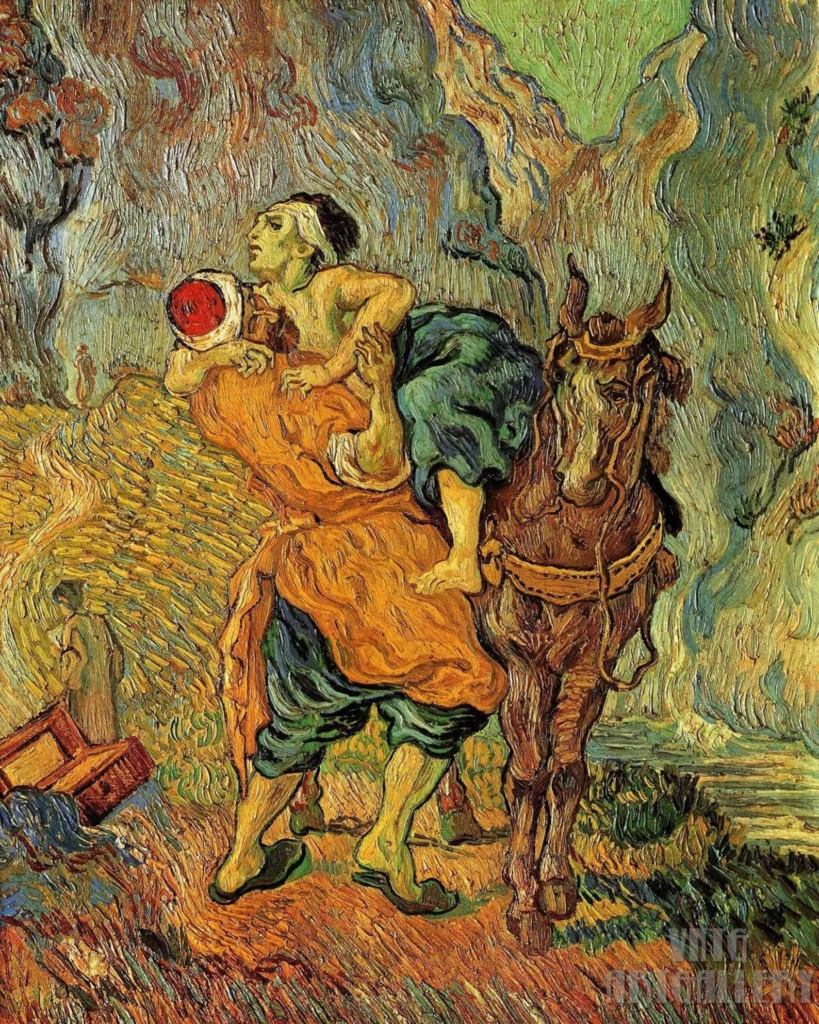
The Good Samaritan, by Van Gogh
Vincent Van Gogh is one of my favourite artists – it’s like the old Don McLean song ‘Starry Starry Night’ which is about Van Gogh; there is such a profound and chaotic beauty about his art that perhaps only the person struggling with sanity can truly see in this world. What I didn’t know about this piece is that it was inspired after a psychotic episode and after seeing Rembrandt’s own The Good Samaritan. Notice how, when you compare it to Rembrandt, here the act of charity by the Good Samaritan seems more burdensome. The victim of the robbery seems very heavy and hard to lift up. I wonder why? Notice also the people passing by – the priest and the Levite – and what’s the open box all about? I think maybe this most famous of Jesus’ parables wouldn’t work so well now – we would be asking too many questions about boundaries and self-care? The Good Samaritan ought to watch his back! I’ve got compassion fatigue! The horse might bolt! The victim of the robbery might not be as sick as he looks! He might be the robber! Boundaries my friend!
Does the Good Samaritan work as a parable of reckless (mad) compassion in today’s society – what Martin Luther King called ‘dangerous compassion’?

Christ in the house of Martha and Mary, by Diago Velazquez
This is a Diego Velazquez painting from the early 17 century. A lot of his early work related Spanish tavern life to Bible stories which is interesting but a bit confusing here. We clearly have Jesus in the background and I guess that is Mary at his feet, listening and learning from the male rabbi which was radical in Biblical times. But who are the three other women? It’s like the mood is true to the story – Jesus teaching while Mary listens and Martha sweats and does the hard work. But isn’t Martha the one arguing or pleading with Jesus? The two characters in the foreground seem ‘added on’ to the Bible story. I guess the message for me is that one person’s freedom is another person’s responsibility. Maybe Martha has abandoned the kitchen too! But someone still has to cook!
Who are the two women in the foreground and how do they complement the story of Mary and Martha? Or are they the sisters?

The Last Supper, by Leonardo Da Vinci
This is an interesting one – made famous these days by Dan Brown’s Da Vinci Code (book and film) which explored the hidden messages and meanings in the very esoteric Da Vinci’s work. You have to allow for the fact that this is not a very realistic painting despite it looking so superficially. Jesus’s disciples would not all have sat one side of a table, as though a camera crew were on the other side; they would not have sat at a table at all. More interesting is how we ‘read’ the characters’ faces and therefore motivations. Can you see Judas? Peter? And is it, as Dan Brown suggested, Mary sitting next to Jesus, on his right? Or is it John?
Look at each character or apostle? What strikes you overall about the mood of The Last Supper and how different might it have been in reality?

Death on a Pale Horse, by William Blake
This is Blake’s interpretation of one of the many visions from the Book of Revelation – the four men of the Apocalypse. I’m one of those who wonder if the book even belongs in the Canon. I have no learned explanation for that feeling save for the dangerous ways it has been literally interpreted and how much it stands against the central vision of a God of Love. There’s so much to see in this picture that you almost can’t make out much at all – and perhaps Blake intended that – it is as chaotic and destructive as Revelation itself. I can see 4 horses and, there in the bottom middle, is that an angel trying to protect someone? One of the ‘saved’ perhaps? And who is the figure in monochrome, also in the centre bottom?
What are we to make of the Book of Revelation? Does it, for you, fit into the story of God?

Jesus Christ, Liberator, by Willis Wheatley,
You’ll see this kind of picture (or variations of it) all over the internet and it’s often called the ‘Laughing Jesus’. Willis Wheatley who was part of the Canadian Church in the 1970s created the original. For me it has always been associated with Liberation Theology. Jesus was for so long portrayed as very serious or pious or simply unreachable by virtue of the halo so often placed around his head by well-meaning artists. There is something really human about this image – a real belly-laugh! And it’s sketched rather than drawn in clear and ponderous detail. It liberates us by stepping outside the boundaries of orthodoxy (and Scripture, where Jesus is never actually said to laugh, though he must have) and showing Jesus filled with joy and with humanity. It is an act of rebellion and challenge and it fits well with Liberation Theology.
How do you feel about Jesus laughing, crying, showing anger? Can you think of places in scripture where he showed human emotions?

The Prodigal Son, by Rembrandt
A copy of this famous picture by Rembrandt hangs in the chapel of St Edmund’s Church in Dartford, though I think the original (slightly more expensive one) is in St Petersburg, Russia. It is of course based on the famous parable told by Jesus to illustrate the unconditional love of God. In short, the younger son demands of his father that he gives him his inheritance now – in effect, wishing his father dead and living as if he were so! Unbelievably hurtful then as it would be now. The son goes off, wastes all the inheritance (hence prodigal) then, with no one else to turn to, returns home, not even hoping to be forgiven by his father, but hoping he might at least work for him and scrape a living.
His father welcomes him with open arms and throws a party. It’s often said of the painting that the father, standing, has a female and a male hand but I can never quite see that. Can you? What I do see is the darkness of those around the father and the son, bathed in light, as they struggle with the idea of a love that bears all and truly knows no bounds.
What does this story tell us about justice and about mercy? From a human perspective? From God’s?

The next two pieces are both by Antonia Doggett, an artist who is based in St Helen’s, Oregon, in the US. You can see more of her work by visiting the Facebook page here: spilt ink gallery & gift shop – search results | Facebook.
Like much of Antonia’s art, her work is somehow both whimsical and profound – whimsical in the sense that it has an endearing cartoon-style format that draws you in and often makes you smile before you study the detail. It’s profound too when you see where the detail is pointing in both concept and messaging. I’ll point out some of the obvious bits of this first piece and leave you to look deeper. There is so much to see and reflect on. The torch on the statue of liberty is not just lit, but on fire, suggesting a sense of urgency for the future of freedom and democracy. She is rising above a country itself under water – is she here a beacon of hope or a warning? The Ark is pointing away from the Statue suggesting the US is not a place to find dry land for the rebirth of God’s vision. If the direction of the Ark wasn’t enough, you also have the ICE boat pulling alongside – not welcome here Noah!
Look at the animals! What about that snake? – Always a symbol of evil and deceit, what is it saying here? And why the parrot on the ICE boat? Any thoughts on that?

This piece, also by Antonia is called Psalm 23 – and the words that echo through the image from that great and much-loved psalm?
‘Yea, though I walk through the valley of the shadow of death, I will fear no evil; for thou art with me’.
The setting could be any town, or city, or community devastated by war. The place is barren as buildings – maybe hospitals or schools or churches or mosques – though they look mostly residential are bombed and destroyed. You can see the after-effects of dropped bombs in the rubble and in the smoke scarring the sky in the background. There are no people. There is a sheep and the sheep walks through this valley, guided by the footsteps of Jesus who walks ahead, but not too far ahead. Jesus walks confidently guiding his sheep, us, through the terrors of war and devastation and suffering to that place where ‘goodness and mercy shall dwell with me all the days of my life.’ It is a promise that though destruction and suffering are real, so too are the promises of God. We are not alone. Nor are the people of Gaza, Israel, the Ukraine, Russia, or any other troubled place on earth. IN the words of Theresa of Avila “Let us do our part, and God will then do what He wills. This is God’s cause, and all will end well. My hope is in Him; do not be distressed.”

Now for something entirely different – this image is produced by AI. I simply typed in ‘Jesus walking on water’ but didn’t select a particular style or medium. AI has gone for traditional/oil.
So – more questions than answers…
Do you like the image – does anything in it suggest to you that it is generated by AI?
Has it added any depth of understanding to the story?
What is art? Is what AI produces art or is it something else? Does it matter?
Can AI truly reach and reflect the depths of what it means to be human in its artistic endeavours? Do we add meaning?
Will AI ever be able to replace the poet, the artist, the theologian, the philosopher? Does it matter? Why? Why not?

The Shadow of Death by Holman Hunt
This picture hangs in the art gallery in Manchester. My first thought was – what on earth is Jesus doing? Some kind of liturgical dance maybe? And I do find it off-putting, as if the main message of the painting as I see it is somehow forced. That main image – as the title suggests – is the foreshadowing of his death on the cross (hence the weird posture). In some ways it is a question of seeing what you can see – so look hard.
The first thing I notice is Mary the mother of Jesus looking not at her son but at his shadow, with the horizontal bar of the cross found in the shelf behind him, holding what could well be interpreted as images of torture and crucifixion. Maybe she sees what is coming before he does, just as she did during the water into wine sign in the Gospel of John. There’s a star above the entrance to the carpentry shop (beyond the entrance is the painting of the Holy land where Holman visited before he created the picture)telling of God’s incarnation and Mary is looking up from a chest of some kind; a chest containing the gifts brought by the magi that fateful day.
What can you see in the painting that points to the purpose and destiny of Jesus? A crown of thorns maybe – and do you notice any symbols of the Resurrection?

The Road to Emmaus, by Rembrandt
In Scripture the story of how two disciples’ encountered their Lord soon after his resurrection is such an engaging one. He is literally walking with them and talking to them, yet they don’t recognise him. There go so many of us! However, something in them senses they should hold on to this stranger so they invite him into their home to sit and eat with them. As he raises the bread to bless it, they recognise this is Jesus their risen Lord and all he has promised is coming to pass. Then he disappears.
Why does this story matter so much? Because it speaks to me of the rituals and sacraments of the Church and how they help us to recognise and experience God where we might otherwise not. Indeed it is said a sacrament (such as the Eucharist) is a visible sign of God’s invisible grace. Yes, they met Jesus on the walk, but they really saw him only in the ritual. We mustn’t underestimate that.
The light in the picture and the receding darkness works to stress the moment of revelation as Jesus breaks the bread and gives thanks for it.