

The American poet Robert Frost once wrote ‘home is the place where, when you go there, they have to take you in’.
Is that a good metaphor or image for unconditional love?
I used to think so, there was something reassuring about it.
You need help, you go home and they’ll help you no matter what. What love could be more unconditional than that?
But read it again. ‘home is the place where, when you go there, they have to take you in’.
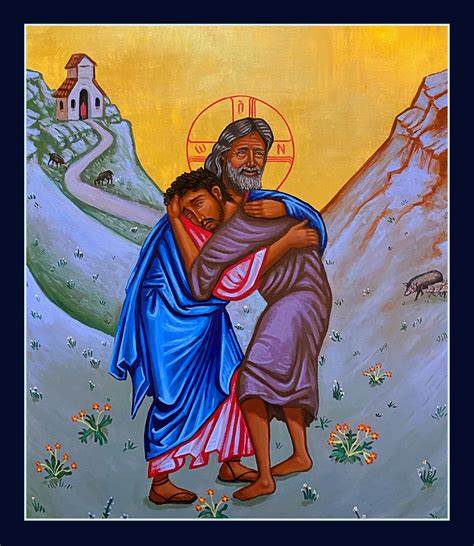
The idea of ‘having’ to take someone in is a bit grudging; doesn’t quite bring to mind the father rushing to embrace his prodigal son; that man didn’t take the son back because he had to, but because he longed to.
It was, ‘I love you, I’m so thankful you came home’. Not ‘well, you’re back are you? Thought you would be. Right’.
Unconditional love is what it says on the tin.
It’s unconditional. No terms and conditions. No small print. No get out clause.
The love of God is unconditional.
Yet many people find it hard to believe God loves them personally; they may find it even harder to believe in a God who loves everyone. Everyone. You might shake your head and say, no, I do believe in a God who loves everyone, but maybe you still feel reasonably comfortable talking about eternal damnation, those many still needing to be saved, or whatever theological language we choose to use to exclude some from what we call the unconditional love of God?
Unconditional Love has no buts. God has no Buts.
It’s often said God loves us not because of who we are, but because of who God is. It makes it sound like we’re unworthy, and requires a huge effort of will on God’s part. Now I’ve said things a bit like that myself – that love is an act of the will. But what I mean is that love, real love, can’t depend on short term feelings. By short term feelings I mean I love you today, but maybe I’ll feel differently tomorrow; I love you when you’re nice to me, not when you’re not.
Christian Love is much more of an act of the will than that, not merely depending on the heat of the moment, but is a conscious determination to love no matter what – enemies as well as friends, ‘for better or for worse’.
The idea that God finds us so unlovable that his love is entirely dependent on who he is and not who we are is wrong. God loves us because we are lovable. God made us – how could we not be lovable? And we are loved ‘for better or for worse’. An act of the will, not a whim that shifts with the ontological winds.
We are God’s cosmic masterpiece. That is to say, we, each one of us, overflow with the divine image of our Creator – made for love, made for meaning. Our souls are things of beauty. That’s all the evangelism we need to do – when we speak of repentance we should speak about it as the means whereby we grow in knowledge of God’s love; when we speak of turning to Christ, we should speak of it as though it were as natural and as good as turning to the Sun for warmth, to food when we are hungry, or to water to quench our thirsty; because we are made to, not because we ought to.
Where do we get our ideas of unconditional love from – possibly, primarily, our parents, I guess, whoever mothers us or fathered us. And so we do often judge God by our parents’ standards – because that is the place where we learn or we don’t learn about unconditional love.
Parental love is often considered unconditional – it isn’t always though – and that fact can define us.
Forgive me for telling this story again; if you come to the Tuesday communion at St Alban’s you may have heard it but it illustrates something important.
A child asked its mother if she really loved them. They knew it was a game – and that’s important because it meant that they could play this game knowing it would go well for them – but they played it incredibly well. It went along these lines: mum, if I stole something would you love me?
Mum thinking – please tell me you haven’t stolen something.
Mum says, yes; I would.
if I got excluded from school would you still love me? Yes!
if I was Hitler?
(Mum thinking quickly)
But you’re not Hitler!
But if I was Hitler, would you still love me?
Mum: yes. Now please go to sleep.
The mother’s love was unconditional but the child was testing the water. And they could test the water because they trusted the outcome. Had they said, mum, if I were to get excluded from school, would you still love me, and mum had said, no. Imagine. If they had constantly been told in word or deed they were unlovable, imagine. Or there were limits to that love.
when we speak of repentance we should speak about it as the means whereby we grow in knowledge of God’s love; when we speak of turning to Christ, we should speak of it as though it were as natural and as good as turning to the sun for warmth, to food when we are hungry, or to water to quench our thirsty; because we are made to, not because we ought to.
They would not have asked those questions again. They would have been afraid of the answers.
Think of the Prodigal Son.
If the most amazing thing about the prodigal son story is the father’s deep and complete forgiveness, then the second most amazing thing is the prodigal son himself – he had the courage, was desperate enough, yes, but it still took courage and humility, to risk turning back to his father, – how could he do that? He had wished his father dead. But, he had in the past experienced enough unconditional love in that relationship to believe some kind of restoration was possible and to seek it. It wasn’t just desperation.
The Prodigal Son knew what unconditional love looked like, felt like, and so his healing, his restoration was possible. He knew himself loved once, unconditionally, even if he could not imagine himself loved now. But he was. What if his experience of parental love was so damaged and so damaging he could not believe it wise to go home? Even to be just a farm hand?
Then that love, still there, still unconditional, would not have been experienced. The Prodigal Son would never have gone home.
The unconditional love of God has no conditions. Seek and you shall find.
It’s the seeking that’s the hard bit.
But what if you can’t bring yourself to seek – what if you believe you are unforgivable; unlovable, beyond redemption, because in your past, that is what others have told you or allowed you to believe? How then do we ask these people to turn and experience the unconditional love of God?
We all long for unconditional love. If we’re lucky, we don’t need to long for it. It just is. It’s there in the arms of a loving parental figure, in the unconditional care of a spouse or partner. For many of us, experience tells us it can be taken for granted, depended on, we are lovable.
But human parental love isn’t always unconditional – for many of us, if we’re honest, with ourselves at least, it is sometimes a deeply flawed, very human and problematic love too. And where parental love is problematic, we know it can carry on through the rest of a person’s life, making it hard to have confidence in one’s own ability to love and to be loved. Abuse of any kind can do the same. Feeling unloved makes it hard to respond to love. The prodigal son could respond to love. That was the gift his father had given him, long before this story. Not everyone can. Remember that when you’re telling someone God loves them.
Can they hear you?
You want them to respond to the good news of Jesus’ infinite love, but can they respond?
Are they equipped to do so?
Our mission is to help people respond. To enable them to feel loved. That is why community engagement matters!
I am convinced that neither death nor life, neither angels nor demons, neither the present nor the future, nor any powers, neither height nor depth, nor anything lese in all creation will be able to separate us from the love of God.
If this passage from Romans, 8, isn’t the most comforting passage in the Bible it must be at least one of them surely; you want to share it with everyone and just make sure they are listening. Nothing, nothing at all, can separate us from God. It reassures us as it must have reassured Roman Christians. It is unconditional love. Nothing can diminish it. Nothing.
The passage we have just heard contains all the words that all the damaged people in the world need to hear. A message of love not and not of condemnation. But do they hear it? Can they hear it? If they can’t hear it, how can they respond? And if they don’t hear it does that mean they are not chosen?
Of course not, it means their heart needs healing and that is our job.
To heal hearts.
A story I found online:
N 1937 the Golden gate bridge was finished. It had been completed, I read, in two stages – the first stage, completed slowly, and the second stage, completed quite quickly – and what is fascinating about that fact is this – for the first stage, there were no safety nets for the workers and more than twenty workers fell and perished. For the second stage, a safety net was installed – some men fell but none died. Production went up by 25%. Men felt safe and because they felt safe they could focus on the job.
What we need to do is assure people of just how secure they are in the love of God. Give them the confidence to turn to God, and to come home.
God loves us whether we are lovable or not.
God will hold us when we are too weak to hold ourselves.
God will find us when we are lost.
God will be our refuge in every storm.
Nothing can separate us from the love of God but ourselves, and, sometimes, other people.
There is no ‘God loves me because…’
There is no ‘God loves me but…’
There is no ‘God will love me if…
There is only God loves me…God loves you…no ifs, no buts, no maybes; we may all of us, in one way or another, be damaged souls I suspect; very few get through life without scars; we may all be getting it wrong more often than right, and some of us, sadly, may doubt it is even possible for God to love us; but He does – because while we see our failings and weaknesses so clearly, we hear the criticisms reverberating from childhood or damaging adult relationships so loudly, what God sees , when he looks at you, is a child he made for Love. Every single person on this planet including you, is a little comic miracle; cosmic miracle bursting with potential and beauty.
That is the Gospel truth.

Luke 15:11-32 NIV – The Parable of the Lost Son – Jesus – Bible Gateway

Thank you for reading – I look forward to hearing your thoughts!