
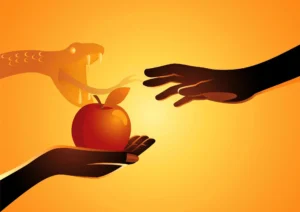

Genesis is the first book of the Bible – a book about origins. I do not take it literally, or believe it was ever intended to be taken so. It was written as a poem, in Hebrew it scans as a poem; it is a poem. We should not be afraid to own that.
It is not true but, like all great poetry, it speaks a truth deeper than prose can, and more profound than literalism enables it to. It is myth in the true sense of that word – a symbolic narrative that reaches into the core of humanity’s deepest spiritual longings. To seemingly trivialise things for a moment, Eastenders and Coronation Street are not true but they contain the great truths of love and life – family, betrayal, sacrifice. It’s all there. If Shakespeare were writing today I’m pretty certain he would be writing scripts for the soaps.
But where does that leave us with Genesis? Recognising its genre does not diminish its value as we seek to understand our place in God’s world. Quite the opposite. It takes God and us out of the box of literalism. We can see things differently; see things better.
Optical illusions are images which can be interpreted in different, often contradictory ways. But because the eye is trained by habit, it requires a shift in perspective to notice something different. And when you see something different for the first time it can take you by surprise. The duck and rabbit illusion is typical. You see the duck and you have to refocus to see the rabbit – some people always see one and never see the other; other examples of optical illusions are the old/or a young lady or the stairs going up or down; is the line straight or curved?
The story of the Fall can feel a bit like that. If you look differently you see differently. The Augustine doctrine of original sin has become so habitual a part of our theological and cultural understanding of Genesis that many people see in it, literally or metaphorically, an account of how and why suffering entered the world. According to the doctrine of the Fall, life was created good by God – ‘God saw that it was good’ – yet it was damaged by disobedience when Adam and Eve ate from the tree of good and evil. This tree was, according to Augustine, a symbol of God’s own dominion over the created order and of humanity’s obligation to respect that hierarchy. When they eat from the tree it is a rejection of that divinely willed plan and an act of disobedience. Humanity – male and female – is therefore sentenced to hard labour and sent out of Eden until Christ comes to redeem them.
For those who are keen to find failings in the Christian concept of God, Genesis is always a good place to start too. Dawkins famously said that Adam and Eve were correct to follow the snake’s advice to eat the forbidden fruit to gain knowledge because ‘ignorance is not bliss and blind obedience is not a virtue’. I kind of agree. But not completely. As always Dawkins hops onto the bandwagon of the most unappealing interpretation and then uses it to justify and share his distaste. Fair enough. But whether you are in the camp of Augustine or Dawkins or, like most of us, somewhere between, it is hard to persuade people outside of the church today that the God of such caricatures is worthy of worship.
We often ponder on God making the world in six days and resting on the seventh. Seven- the number of perfection, of completion. And therefore we assume God made the world as perfect. But to risk splitting hairs for a moment, God made the world in six days (that’s six periods of creation, not six lots of twenty four hours). which suggests he didn’t make it perfect. Like the planet itself with its shifting plates, humans too need wriggle room – space to shift and change. Maybe God didn’t make Adam and Eve to be perfect either but to be perfectly human and also able to grow.
A strong argument for Genesis to be taken literally is also that it explains the presence of so much suffering in the world – that will be addressed in a blog – but let’s look again at an example of suffering in the physical world. If my understand of geology is correct, fault lines and the earthquakes and volcanoes they cause can be terrifying yes, but their purpose is to allow give in the structure of the planet and release pressure that would ultimately be more devastating. The end of the suffering caused by these events is investing more money and energy in understanding them and alleviating the suffering they cause.
Adam and Eve too, through disobedience, come to know good and evil and perhaps then to know eternal life would be the ultimate suffering. Maybe God is protecting them from the tree of eternal life, not protecting the tree of life from Adam and Eve.
Just like the optical illusions there are other ways of reading Genesis and of understanding the Fall, if we can just adjust our vision from what we expect to see through the lens of the church fathers for a moment, or indeed from the radical atheists. Maybe Genesis is a story about suffering but about the suffering of God as well as human beings. God tells Adam and Eve not to eat from the tree of good and evil or they will become like God and so, if they do, and they do, then they must die.
Dawkins sees that as a primary example of the vindictiveness of God. Vindictive and jealous. But God ejects them from Eden to prevent them from eating from the tree of eternal life.
Is preventing someone from being like God a punishment or an act of mercy?
Answers on a postcard!
God is eternal. God knows all that the world is and all that it will be: the future, the present, the past. If tragedies, and pain, and grief hurt us what do they do to God?
Adam and Eve too, through disobedience, come to know good and evil and perhaps then to know eternal life would be the ultimate suffering. Maybe God is protecting them from the tree of eternal life, not protecting the tree of life from Adam and Eve.
To know what God knows is and to see what God sees is perhaps the ultimate in suffering. If we look beyond habitual understanding we still see in Genesis profound truths about the relationship of God to his world and to his people and we can see that it is already a relationship of grace.
And the Lord God said, “The man has now become like one of us, knowing good and evil. He must not be allowed to reach out his hand and take also from the tree of life and eat, and live forever.
Genesis 3: 22
Genesis 3:1-6 NIV – The Fall – Now the serpent was more – Bible Gateway
Genesis 3: 21-24 NIV – The LORD God made garments of skin for – Bible Gateway
Thank you for reading – I look forward to hearing your thoughts!