

In the film Bruce Almighty, Bruce is a minor tv personality who feels hard done-by. He misses his big chance to succeed at work, he loses his job, he is beaten up, and it is all the fault, he says, of a God he claims not to believe in. He claims that God is picking on him; no, worse than that, God is ignoring him.
We live in an age of entitlement – I generalise wildly; of course I do, but I know and you know that there is a mindset out there (evident on social media) that I deserve everyone’s attention and understanding all of the time; my problems are almost always caused by someone else; I am always more sinned against than sinning, Why is God picking on me? I don’t believe in God yet I’m disappointed when my prayers go unanswered.
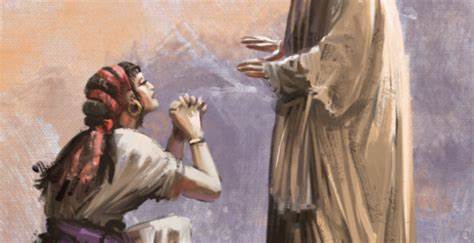
In this cultural context the story of the faith of this woman is quite extraordinary. Jesus behaves in an incredible way and so too does she. He seems to be acting out of character; his response to a woman in great need seems harsh, callous, un-Christ-like. And if Jesus can’t be like Jesus what chance do the rest of us have?
She is begging for her child’s life and he chooses to ignore her. When he finally speaks it feels almost as if it might have been better if he hadn’t bothered. It is not right to take the children’s bread and toss it to the dogs, he tells her. Say what?
Jesus is seeking to withdraw from public attention, needing some time for rest and recuperation, but as is often the case, he is unable to keep his presence secret. A gentile woman (therefore a foreigner) approaches him to ask for deliverance for her daughter and Jesus appears to insult her with a racist slur by calling her a ‘dog’. It’s one of the most unsettling passages in the New Testament. This isn’t the Jesus Christians like to think about. This is Jesus apparently insulting and dehumanizing a desperate woman seeking the life of her child. This is Jesus writing Gentiles off as second-tier citizens…Jesus’ statement was full of prejudice and ethnocentrism.
Yet her stubborn faith persists, and her humble response to Jesus’ ‘insult’ persuades him to act, so her daughter is delivered and healed.
To our ears it all seems wrong. So we try to rationalise it. Why does Jesus act the way he does?
Answers on a postcard…
Do we at this moment see the cogs turn in God’s mind as he perhaps at this time develops his own understanding of his mission as he did during the wedding at Cana? Remember his mum prompted him into his first miracle. Now this woman prompts him into the idea of universal salvation.
Or, Was he a man of his time and perhaps, whisper it, a tad racist? But no one, no one, spoke up more for the outsider. Yet what we call racist first century Palestinians would see as cultural givens.
Or is he perhaps testing his disciples? This passage follows on immediately from the debate about what is clean and unclean? Had they been listening? Did they understand that neither race nor gender could leave you unclean? Does he fall silent to see what they might say or do? Is he always intent on helping her?
Jesus is silent at this juncture.
We don’t know. And neither I guess does she?
We can’t know the mind of God. Neither does she. That is the point.
But with immense humility and courage and faith that Jesus is brings salvation and healing, she persists. She does not challenge Jesus’ summary that the people of Israel are God’s children and that the gentiles are merely the dogs. Dogs of course were considered unclean; gentiles were considered unclean. She accepts the analogy.
She does not disagree with his claim that you do not give to the dogs what is rightfully for the children. For love, the love of her child, she is willing to accept the crumbs. Yep, maybe I don’t deserve your attention, but I don’t care about what I deserve; this isn’t about me; I need your help; I need your grace. My child is sick.
For the love of her child, the crumbs will do.
Her resilience, her self-awareness, her faith, her love, her humility and most of all her absolute vulnerability, all combine to illustrate a way of coming before God. None of us are clean; none of us can claim God’s attention, like Bruce Almighty, because of who we are, only because of who God is. None of us can really feel that confident of our claim. And God, in his mercy and grace, gives us much more than we can ever hope to deserve.
That vulnerability. Such a difficult word to hear. Such a difficult thing to be.
We cover up our vulnerabilities don’t we. I do.
Not sure why?
Maybe we really don’t like to be thought of as ‘weak’, or as needing others.
Maybe we fear being judged or rejected, or just pitied. I don’t know.
Or we fear being hurt again, in the same way.
Or we want to be the strong one. Because our culture values strength.
We’re often taught about Jesus’ vulnerabilities on the cross, how he made himself vulnerable for our sakes. Thank God he didn’t want to be or need to be the strong one at that moment. And yet, our macho culture gets in the way, and we still try not to admit to weaknesses, to fears, to doubts. We struggle to let others see just how much we are struggling. And yet it’s the bravest and best thing we can do for others sometimes. And the most Christ-like.
We struggle to let others see just how much we are struggling. And yet it’s the bravest and best thing we can do for others sometimes. And the most Christ-like.
The most Christ-like thing we can do for ourselves and our neighbour, is to put ourselves on the cross of vulnerability and say, this is me, it’s not all of me, but this fear, this anxiety, this weakness is a part of who and where I am right now, and that’s ok.
We need to be more like that woman in the Gospel.
I bet that woman had been rejected many times, she was scared and vulnerable, because she was Greek, because she was a woman, because her daughter was sick. I bet she didn’t really want to beg this Jewish rabbi and his perhaps cocky over-bearing friends; but she was desperate, and she risked it, because some how she knew who Jesus was and that the risk of vulnerability was worth taking and would bring healing.
A lovely postscript – we don’t know her name, do we? We never do.
The traditionalists among us, and I’m one, will know the words of humble access in the Book of Common Prayer communion service.
It goes like this…
We do not presume to come to this thy Table, O merciful Lord, trusting in our own righteousness, but in thy manifold and great mercies. We are not worthy so much as to gather up the crumbs under thy Table. But thou art the same Lord, whose property is always to have mercy: Grant us therefore, gracious Lord, so to eat the flesh of thy dear Son Jesus Christ, and to drink his blood, that our sinful bodies may be made clean by his body, and our souls washed through his most precious blood, and that we may evermore dwell in him, and he in us. Amen.
In the Common Worship Communion service, the words go ‘most merciful Lord, your love compels us to come in, Our hands were unclean, our hearts were unprepared; we were not fit to eat the crumbs under your table…’
Some people love the prayer of humble approach, some, I know, are not so keen. It certainly doesn’t sit well with the age of entitlement we live in. But we will go to the altar rail empty handed, with nothing to offer, just our own brokenness. Having nothing but receiving everything. Just like this unnamed woman.
It is her words, her faith, the woman known for her great humility and vulnerability, who is honoured in that prayer of humble approach.
We come to the altar empty handed, not to demand but to plead,
Not to take but to receive,
Healing for ourselves.
Healing for the world. Come as you are, come as that woman did
And so we come.
He replied, “It is not right to take the children’s bread and toss it to the dogs.”
Matthew 15: 26-27
27 “Yes it is, Lord,” she said. “Even the dogs eat the crumbs that fall from their master’s table.”
Matthew 15:21-28 NIV – The Faith of a Canaanite Woman – Bible Gateway
Thank you for reading – I look forward to hearing your thoughts!