

In one of the children’s Bibles it says, as motivation for torturing and killing Jesus, ‘Some people did not like Jesus talking about God’.
Sometimes the children’s way of saying things is so much more to the point.
Some people did not like Jesus talking about God.
For those who are not very familiar with Holy Week. let me offer a bit of context.
Holy Week is the period between the day called Palm Sunday, and the following Sunday – which is Easter Day.
And for sure so much happens in this week.
Nick Page calls it ‘the longest week’ in his amazing book. Whatever you believe, creation turned on its axis this particular week. There has been nothing like it before or since. But just a quick resume so to speak….
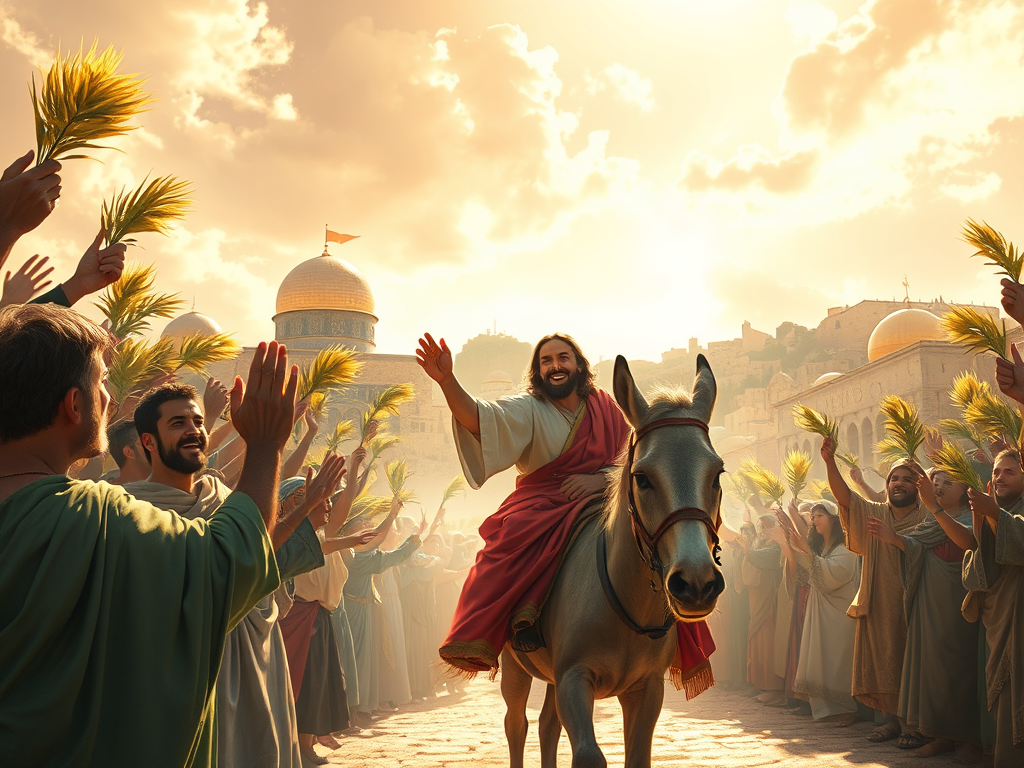
On Palm Sunday, Jesus arrives in Jerusalem for Passover; he arrives on a colt amid much celebration and cheering – a lot of waving of palms. The reputation of Jesus goes before him; he has healed people, raised Lazarus from the dead, stood up to human power and stood up for the weak and the oppressed. He is loved. He is different. He is hope. He is the Messiah foretold in the Old Testament, he must be. The clues are there.
He is the one who will set the Jewish people free from this cruel Roman oppression, Romans who mock their faith, and kill their hope.
Jesus is riding on a colt – not a great look – think a grown man on a kid’s bike – but even that is foretold.
They love him. They cheer him. They wave their palms – just first century bunting and balloons really. If only it could stop there.
Press pause.
Quit while you’re ahead, Jesus. Quit on Palm Sunday.
But Jesus has a date with destiny. And during the week in Jerusalem he goes at it with the most reckless courage. He spends the coming week – Holy Week – winding up powerful and dangerous people. He’s spent the last weeks and months winding them up anyway. But now he goes for it like a man for whom time, human time, is running out. And who has the Kingdom of God to reveal still. He needs people to understand. They haven’t yet.
So what does he do in this week we call Holy?
He trashes the temple – he says the religious leaders have turned this Holy site into a den for thieves. He turns the tables over; he causes mayhem. He draws attention to himself.
He scoffs and says that if the temple were to fall, he could rebuild it in three days.
We know he’s talking about his death and the Resurrection; they don’t.
He says loud and proud that the poor woman who gives two pennies to God is giving more than the rich who flaunt all their giving.
He is winding and winding and winding.
And these powerful people want him dead.
Some people did not like Jesus talking about God.
They want him dead.
And they will have their way in five days; on Good Friday.
And the people who are not powerful, who once loved him, the ones who cried Hosanna, now also seem to want him dead.
Those who called Hosanna now shout crucify? Would they do that? Are human beings that fickle? What’s the matter with them?
But who says they were the same people?
This is important.
Thousands upon thousands of Jews would come to the temple for Passover; remember, as Page put it, Herod had learned how to sell religion.
Many would probably not have heard of Jesus, some would have heard and not have cared. We know how the city was divided economically – the wealth in some parts of Jerusalem – great wealth and with it, great power. In other parts, slums and tenements, people living on top of each other with the smell of crap and urine – people living in ways that mean they had not a hope in hell of keeping religious purity laws.
I reckon they were the ones shouting Hosanna on Palm Sunday.
An entirely different breed shouted Crucify five days later.
You see there were two processions going on, and they sum up the essence of Holy Week.
Thousands and thousands of people converging on one city is always trouble. Whether it’s for an international footie match these days or Passover in Jesus’ time.
All these people have to be managed. Hot, tired, excited – it could all go so wrong. It could all go wrong.
On one notorious occasion, Page tells us, a soldier literally bared his backside to the Jews – in the ensuing anger and rage, 30,000 people died. True story.
Most of the security lay in the hands of the temple police but, for major potential flash points, Pontius Pilate came to town – just to keep an eye on things.
Maybe just before Jesus, maybe just after and certainly on the other side of the city..
So you have this fascinating juxtaposition. Jesus… coming in from one side of the city, on a colt a few sizes too small for him, with his rag tag disciples walking beside him, hot and tired, living hand to mouth, welcomed by the poor and the dispossessed. The lost and the lame, cheering him and singing their hosannahs. Meanwhile, or thereabouts, Pilate comes in with his lot. Ready to hand over the ceremonial robes to Caiaphas, ready to stop any trouble, – ready to remind the jews who were in charge.
Pilate and his entourage – Armour and leather; cavalrymen in horseback; Imperial eagle – the symbol of Roman power at the front – leading the procession
On this side, Pilate, representing the love of power, on the other side of the city, Jesus, the Word made flesh – the power of love.
This is the choice Holy Week gave to the people – then and, indeed, now.
To the leaders of the temple, to the scribes and the pharisees, to the Romans; to the pilgrims, to the poor, and to the dispossessed.
Pick a side.
Which King are you going to choose?
The rule of Rome; human domination.
Or the Kingdom of God?
The love of power or the power of Love?
Holy week – just seven days – represents a clash of world views: And says, whose side are we on?
The side of the powerful or the powerless –
That first holy Week Jesus says to the powerful do your worst, and they did.
Two thousand years later, Jesus still says to the powerful, do your worst, and still they do.
The side of the strong or the side of the weak. Holy Week says pick a lane. And as this week progresses it seems to be the weak who go to the wall; the ones who cry hosanna are silenced; the ones who cry crucify are heard.
And a man, the son of God, the Word of Love made flesh, is beaten, tortured and nailed to a cross between two thieves. Without a place even to call his own grave.
The Love of Power defeats the Power of Love.
Or so it seems.
That first holy Week Jesus says to the powerful do your worst, and they did.
Two thousand years later, Jesus still says to the powerful, do your worst, and still they do.
And it seems doesn’t it that the love of power still wins.
We see billionaires playing fast and loose with stock markets,
We see immigrants, living in doubt and fear for their future.
We see good people silenced.
We see fake news becoming real news, and real news dismissed as fake. Because of a narrative that powerful people have established to serve their needs.
Brute force is in the ascendancy. Again.
As it was first Holy Week.
Nothing has changed and yet, wait, Easter is coming, and actually everything has changed.
Love does win.
This is the week when we ask will love win or will love die?
Will the oppressive powers that be crush Jesus or not?
This is the week we ask the question that echoes down the ages of war, and suffering and injustice – which is stronger, the power of love or the love of power?
Thanks to Easter, we know the answer.
Some people did not like Jesus talking about God.
A Children’s bible
They sent soldiers to take him away.
Matthew 21:1-11 NIV – Jesus Comes to Jerusalem as King – As – Bible Gateway
Thank you for reading – I look forward to hearing your thoughts!