
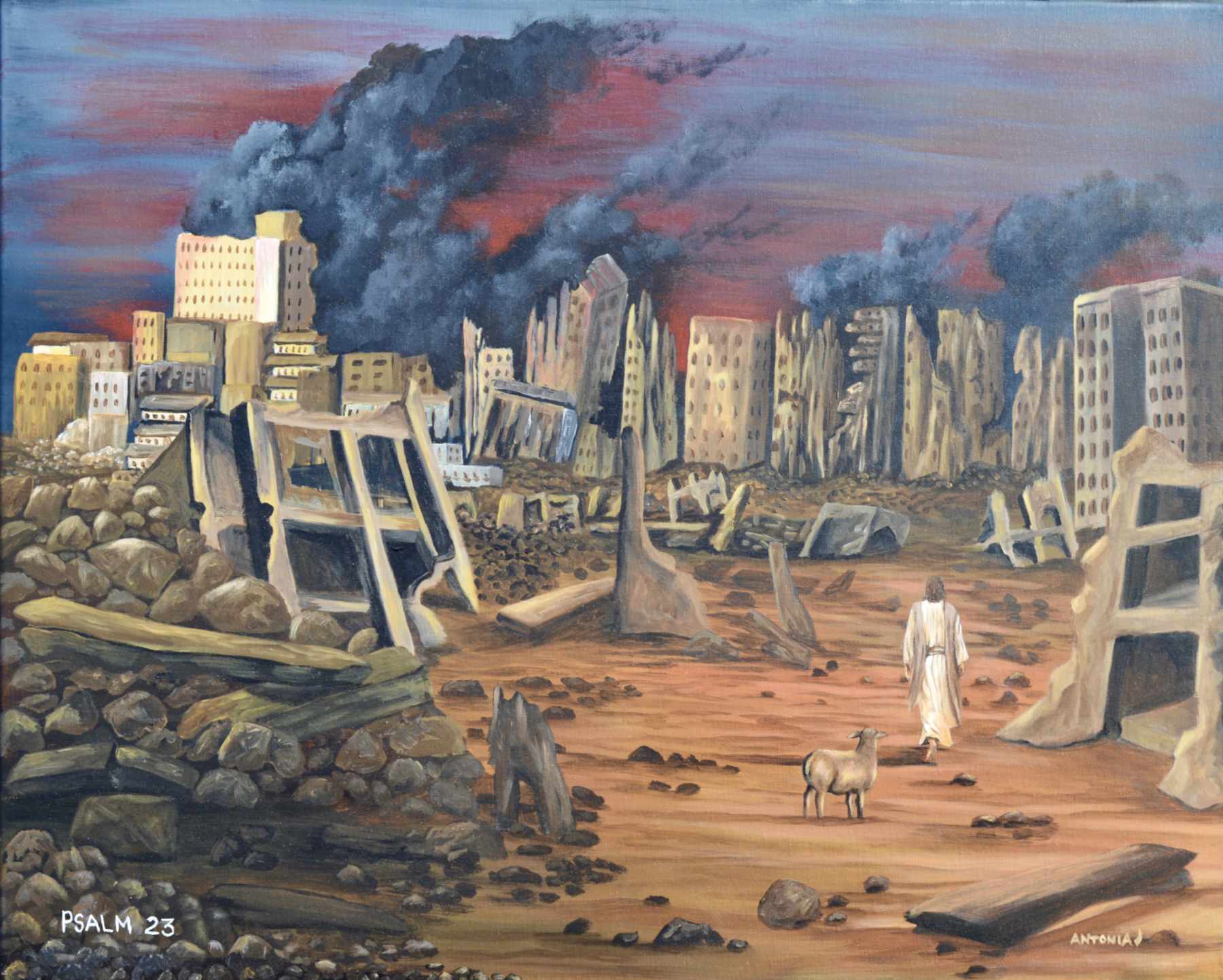
This picture is by my old school friend Antonia Doggett, an artist now based in Portland, in the US. It shows the figure of Jesus with a sheep following close by. Jesus is walking through a landscape, in this case Gaza, but which could be any ‘valley of the shadow of death’ gutted by bombs. For me it gives the lie to the idea of ‘suicidal empathy’, (the idea that empathy can be self-destructive for western societies) a phrase so beloved by Musk and promoted by his millions of followers on X. For what is the Incarnation, God making God’s home among us, if not the very last word on empathy?
I’ve not had much sleep. Alongside the World Cup, with ‘kick offs’ at all times of the day and night, I’ve also been following the Makerfield by-election. Manchester seems to be the place where it’s all happening at the moment! We had the Gorton and Denton by-election (I have belatedly discovered I live in that constituency). Andy Burnham has now been elected MP for Makerfield and therefore, very soon, there will be another election for the new Greater Manchester Mayor. It’s exhausting but I love it.
At least the part of me fascinated by politics loves it. The part of me more concerned with Christian mission struggles with all the division and angry words, especially on line. I shouldn’t use the phrase the ‘part of me’ – I don’t separate into two people that easily. And to be clear my politics is formed totally by my faith, not vice versa. I engage with the political landscape because my faith demands it – do justice, love mercy, says the prophet Micah categorically. Both require political engagement.
But Christianity requires us to be people of reconciliation as well as people of justice and mercy. Those commitments don’t always sit comfortably together. Seeking justice for the marginalised might need us to be confrontational. Being peace-makers might require us to know when to speak and when to stay silent. Either way one of the greatest victims of our divided and distorted political world, other than actual living, breathing, suffering human beings who need us to work together, is surely empathy – entering into the lived experience of those we deem ‘other’.
Empathy has I guess become risky because the more polarised we are, the more we feel we must defend our own perspective no matter how irrational or dishonest it becomes – we have after all invested a great deal in it. To see the other’s point of view becomes too compromising. What if we find something to agree on? What if, God forbid, they have a point? Will that make us look like fools? Will the whole edifice of certainty we have built around us come crumbling down?

We harden our hearts, and we become more extreme. We dismiss empathy as problematic and dangerous; it is a manufactured concept that lacks all meaning; we can’t feel what others feel, see through the eyes of other people. That’s ridiculous. Empathy is simply ‘woke nonsense’. So let’s breathe and carry on being as self-absorbed as we like.
Empathy is not the same as sympathy or compassion. It is much, much more. Compassion I would say might be seeing on our screens children starving in some far away land and being aghast at that. Thinking how awful it must be and promising ourselves that we will contribute more to charitable endeavours. Now compassion literally means to suffer with (passion/suffer and com/with) but in the way of language evolution, it has come to mean something far less. Compassion might lead us to feel deeply sorry for them, it might motivate us to seek political changes. But we would not be suffering with them. Compassion as we use the word nowadays involves a certain kindly detachment.
Empathy on the other hand would compel us to imagine that the child starving might be someone we love. Imagine how much stronger and more intense the desire to make changes in favour of their right to life would be then – if it was your child who cried as a fly crawled over its face, too hungry to find the energy to swat it away? Empathy is what compassion used to mean, feeling the suffering of others as if it were intimately and utterly connected to us. Suffering with them. Compassion is the state of a benevolent intellect; empathy is the state of a working and flourishing imagination. It is a gift from God and we can’t afford to lose it.
Elon Musk famously has much to say on the subject of empathy. On a podcast called the Joe Rogan Experience, Musk described empathy as ‘the fundamental weakness of western civilisation’. He spoke in particularly of ‘suicidal empathy’ which I guess is self- explanatory, and was originally a phrase coined by Canadian professor, Gad Saad. Now Musk’s appraisal of empathy was to be fair a bit nuanced. He thought it was important to care for individuals but felt that such compassion should not override protection of ‘civilisations’. It was in essence an argument against mass immigration to Western countries, and if he was trying to be nuanced, his platform X left that good intention behind very quickly. It has led, with his support, encouragement and reposting, to untrammelled hatred of the ‘foreigner’, whatever the context, enabling some on the margins to be openly racist without a twinge of regret. Empathy, after all, is naïve at best, suicidal at worst.
I understand the argument that too much untrammelled immigration might change the shape of our traditions. But often an intelligent conversation about migration numbers has become a shouting match about how all immigration is bad, all immigrants are ‘illegal’, how Muslims in particular don’t respect our values and fail to integrate (nonsense). It has allowed the likes of far right politicians like Farage and Lowe to promote loathing of the ‘other’ and muddy the waters of the original conversation. It has held open the door for white supremacists to be more blatant.
As Christians, we are called to be people of reconciliation. But reconciliation is driven in the end by empathy. Seeing the world as others see it. Those we agree with and those we don’t. And it can be hard; it can be very hard; empathising with those whose views seem to promote hating. The hardest test of empathy for me has always been wanting reconciliation with those who post those laughing emojis that curiously turn up on social media posts reporting the death of a child in the Channel. Am I supposed to empathise with those idiots? Something is making them tick, something is making them cruel. And they too are human made in the image of God.
What is the Incarnation, God making God’s home among us, if not the very last word on empathy?
Empathy is at the heart of the Christian faith. That every human being is made in God’s image, carries the divine spark, is the most straightforward example of that, if not the easiest to live by. But if we believe it to be so, then we need to seek out and honour that spark in every human being, whether we agree with them or not. It links to the command to love one’s enemies – that is dreadfully hard, but if we see them as like us, and can pray for them in a spirit of reconciliation, we are at least on our way.
Elon Musk’s concern settles on the idea that too much empathy is a risk to civilisation. Is it hyperbolic to say that every time Jesus sided with the poor, with the dispossessed, with the lepers, the women, the children; every time he challenged the law and traditions and those who upheld them, he too was ‘guilty’ of a kind of ‘suicidal empathy’? When he favoured the outcast, when he defended the woman caught in adultery, or allowed his disciples to pick corn on the Sabbath, Jesus was challenging the legal and religious norms that protected the Jewish world of his day from the onslaught of Rome. Nevertheless Jesus spoke out again and again in favour of justice and mercy and love of enemies whatever the cultural cost – and the price he paid was the cross.
In the Incarnation, God ‘moved into the neighbourhood ‘ as it says in The Message, God came to us, became like one of us, to see and feel and think and bleed as humans do, in order to enable reconciliation with the whole of the created order. In the incarnation the cry for justice and mercy comes together with the need for Reconciliation. The one demands the other. God risked all, endured everything, to guide people, people who called for his death, safely home to where love reconciles all.? We don’t have to go that far, maybe as humans utterly invested in our own views, we can’t go that far. But for the love of God we must try and we can begin by agreeing that Elon Musk is wrong. Empathy is at the very heart of who we are called to be.
Is there some meaning to this life?
What purpose lies behind the strife?
Whence do we come, where are we bound?
These cold questions echo and resound
through each day, each lonely night.
We long to find the splendid light
that will cast a revelatory beam
upon the meaning of the human dream.
Courage, love, friendship,
compassion, and empathy
lift us above the simple beasts
and define humanity.
Thank you for reading – I look forward to hearing your thoughts!