
What did Jesus mean when he said the poor are always with us?
I ask myself this question once again – I often have asked it – because of conversations heard on the news last week. Was Jesus saying poverty is part of the fabric of life and as inevitable as the earth rotating around the sun, or was he saying something more challenging and more troubling about human nature?
One such news item involved Gary Lineker. He was leading a group of over 100 millionaires in asking government to tax them more for the sake of providing much needed revenue. Wow, I thought – who could not think this a great and noble thing! We’re always being told the very rich will leave the country if they’re taxed more and yet, here some were asking for just that. But some of the very wealthy opposed it – if you want to pay more tax do it voluntarily, they said! Leave us out of it! Others argued that it was virtue-signalling (a strange concept which I am sure Jesus might have been accused of by his detractors too!) Or maybe Lineker was guilty of rank hypocrisy; hadn’t he fought HMRC to get his tax reduced just a few years back? He hadn’t, but that’s another story. My point is Lineker had offered with others to play his part in building up public services for the good of everyone. But for many, that offer was met with a sneer and the glee to undermine him. Nothing as odd as folk who would rather score points than build hospitals and libraries.
There was also some news that Burnham was knocking a few pence off energy VAT, and capping the cost of bus fares at two pounds. Some didn’t like that either! ‘What good is that to me?’ one chap wailed on X; ‘I have a car!’
But the really fascinating study of human nature came with an interview on the Nick Ferrari show on LBC. He was speaking to an expert on the causes and reality of poverty. You’d think they might know a thing or two. But the host wasn’t having it! He knew better. Let me explain.
‘And pity would be no more, if we did not make somebody poor’.
William Blake: Songs of Innocence and Experience
The Sutton Trust was founded in 1997 with the desire to support better opportunities and social mobility for disadvantaged youngsters. Their work involves research into poverty and its causes. The most recent research noted shockingly that during the last six months 7.4 million households had been unable to buy an essential item. This research was presented on Ferrari’s show last week by a Joseph Rowntree rep. The spokesperson noted that the essentials many families are doing without may be food, or gas for cooking and heating, (making it possible for kids to, say, do their homework in a separate room); the essential item lacking might be toiletries, even a simple toothbrush.
Nick Ferrari cottoned on to the idea that these toiletries might include a toothbrush and he used that massive insight to try to destroy the argument that anyone could really be said to be struggling to such an extent. He said, quite gleefully, and I quote: ‘a bar of soap at Asda costs you thirty pence; and I can get you two toothbrushes at the pound shop for a pound. So we’ve had a nice wash and we’ve brushed our teeth. Why don’t we go out and get a job?’

I now call this argument ‘the Ferrari fallacy’ not least because he has used the toothbrush argument before. He clearly likes it!
Imagine a family of four. They earn x amount, but the outgoings are x+200 pounds. Half of their income, probably much more, goes on renting their home from a landlord in the private sector. Then there is gas and electric to pay for, water rates, internet, council tax, food and drink, clothes; mum and dad don’t smoke but they do run a small car. They’ve thought about giving it up – it’s kind of a luxury of course – and the tax, insurance and petrol all add to the monthly burden, but without it, you would need to pay for bus fares. Work is a good few miles away.
Colour it in further at will. And, yes, before you ask, they have a phone – imagine navigating the 21st century without one? But it isn’t classified as an essential. A toothbrush is.
If your outgoings are 200 pounds greater than what is coming in, then you have to go without things every month – and sometimes that thing you have to go without might well be an essential. New shoes for the kids, sufficient food or, yes, even a toothbrush. If you had to choose between spending your last pound on bread or two toothbrushes (Ferrari was keen to point out you buy two for a pound at a Pound Shop) which would you go for – sandwiches tonight or tooth decay in a few years? Nick Ferrari didn’t understand, or perhaps his listening figures required him not to admit he did. I stopped listening – all I know is when you’re poor nothing is ever as simple as those with money manage to make it sound.
But it made me look once again at the story in the Bible where Jesus tells his disciples quite categorically – ‘the poor you will always have with you’. What did he mean? And based on these recent debates, how true is the observation still?
Jesus is at Bethany, just a couple of miles from the Holy City of Jerusalem. It’s coming up to Passover and therefore only days before the Crucifixion. He takes rest among friends at the home of Simon the Leper, a man who I guess had been cured of leprosy by Jesus, which would explain the warmth and significance of the invitation.
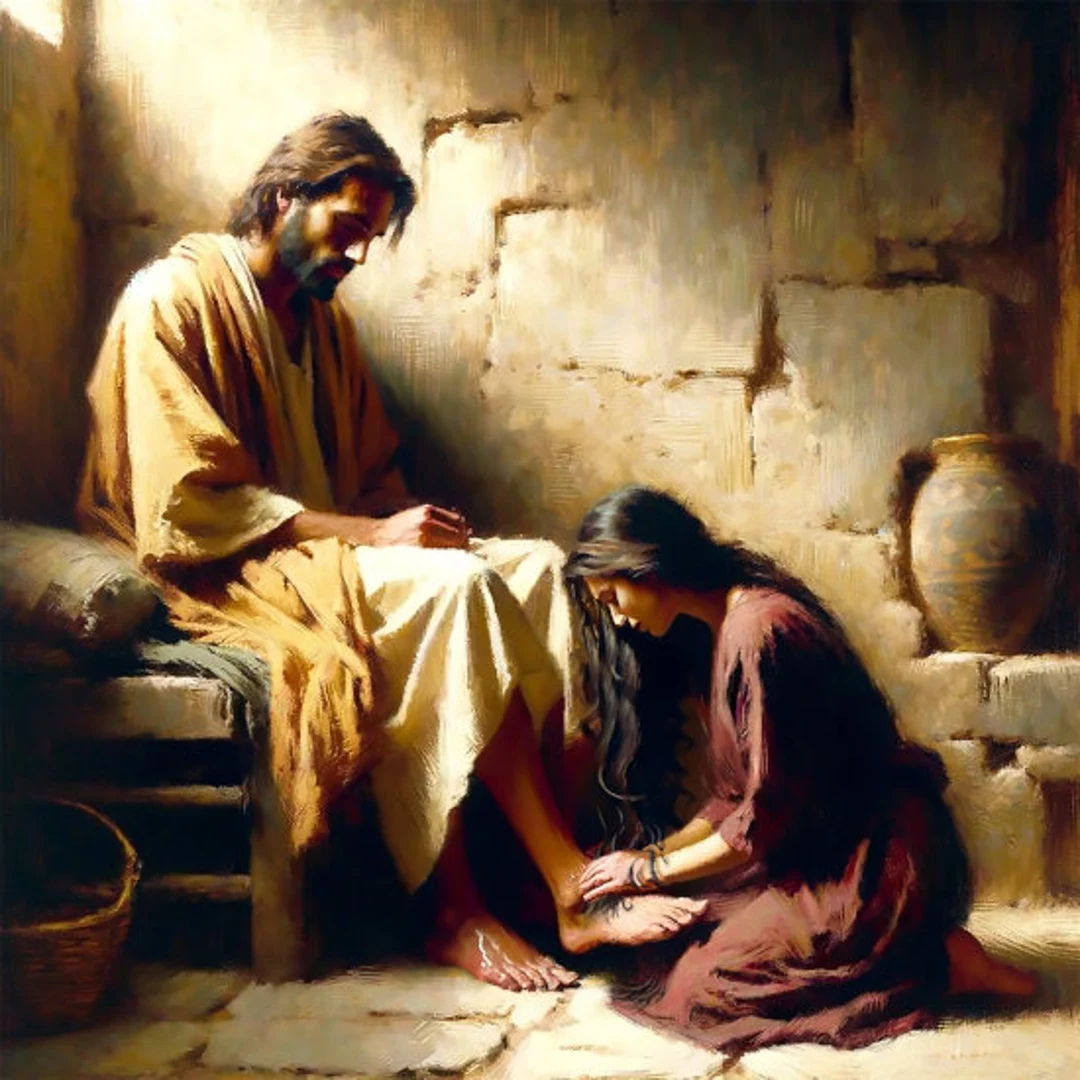
During or after the meal a woman comes to Jesus and anoints him. Depending on the Gospel you read, this woman was either Mary, the sister of Lazarus, who anoints Jesus’ feet, or an unnamed woman who anoints his head. Either way, the symbolism is huge – in ancient Judaism anointing was an act of consecration, of honouring, but it was also a rite that was preparation for burial and Jesus is on the journey towards his death.
In each Gospel it is made clear that the perfume used is pure nard and so incredibly expensive. In Mark we learn that it would have cost three hundred denarii, the equivalent of a year’s wages. A massive amount and a mind-blowing extravagance on the part of the woman even if she were rich. No wonder the disciples are aghast and turn on her. For goodness sake, they tell Jesus, how many poor people could have been fed with this much money? What’s wrong with you? (Paraphrasing!)
When you’re poor nothing is ever as simple as those with money make it sound.
Nobody reading the story wants the woman to be so humiliated; it is such an act of faith and humility. But we are nevertheless surprised by what Jesus does say in her defence. Hr tells them to leave her alone but, not only that, he says that what she has done for him will be honoured down the centuries wherever the Gospel is heard. And the knockout punch. Yes, this could have been used to feed the poor, but ‘the poor you will always have with you, and you can help them anytime you want. But you will not always have me‘. (Mark 14)
These lines have always troubled me. The poor you will always have with you? Why? Aren’t we meant to be building God’s kingdom of love and justice on this earth? Didn’t Jesus defend the poor and dispossessed at every turn and didn’t he say what you do for the least of these, you do for me? Was he saying here we shouldn’t bother with messy stuff like social justice? Are those who say we should not ‘politicise’ the Bible correct? Just keep your mind on the world to come, and accept this one as it is, however bleak and unjust and cruel it is for some. Poverty is inevitable they say, and maybe a blessing for those who are poor and for those who care for them. Mother Theresa argued something similar.
But Jesus wasn’t a fatalist. And he wasn’t a pragmatist – pragmatists don’t get themselves nailed to a cross. His statement here is not just a shrug of the shoulders. It is factually true that the poor the disciples wished to serve would still exist in a few days time, after Jesus’ death. So, at its most basic, the statement was an accurate one.
But we know too the Gospel is de facto political in the broadest sense, because it is about changing the world, about turning it upside down.
Remember those beautiful and revolutionary lines from the Magnificat: ‘He hath put down the mighty from their seat: and hath exalted the humble and meek/ He hath filled the hungry with good things: and the rich he hath sent empty away’. The God who inspires these words of Mary in Luke’s Gospel is not indifferent to the poor. And when Jesus challenged Mosaic Law he was challenging the political as well as the religious law of the day. He cared deeply for the poor and the dispossessed; he spoke up for them with the voice of God. No more, no less.
Yet the church has seemed often to legitimise such hierarchies. Think of the hymns we have sung in churches without even pondering what they mean in the real world: All Things Bright and Beautiful, for example, where the following verse glorifies injustice as the natural and divine order of things:
The rich man in his castle/ The poor man at his gate/ He made them high and lowly/ And ordered their estate.
Or, from the famous Christmas carol, Good King Wencelas:
Good King Wenceslas looked out, on the Feast of Stephen,
When the snow lay round about, deep and crisp and even;
Brightly shone the moon that night, tho’ the frost was cruel,
When a poor man came in sight, gath’ring winter fuel.
It finishes of course with the equally important doctrine of charity, with the lines:
In his master’s steps he trod, where the snow lay dinted;
Heat was in the very sod which the saint had printed.
Therefore, Christian men, be sure, wealth or rank possessing,
Ye who now will bless the poor, shall yourselves find blessing.
But charity is never enough; the Kingdom of God is not built on the shifting sands of charity which, as noble as it is, is also on its own notoriously uncertain and unpredictable, but on the solid rocks of Christ-like justice and grace. Poverty mars the image of God in people.
I finish this blog with one thought – have you ever wondered why the Angel Gabriel appeared to shepherds in the field that first Christmas? Have you ever asked why Jesus chose such ‘failures’ in human terms to be his first disciples – a hot-headed fisherman, a loathed tax collector, a man who would ultimately betray him for just thirty pieces of silver, and others who simply failed to ‘get it’ but were still willing to walk with him? Jesus came to change the world, to build the Kingdom of heaven here on earth. He could have chosen the rich and powerful, those invested in this world as it is, and therefore with no real desire to turn things upside down thank you. If you want the world to be better, ask those who long for it to be so.
Yes, Jesus said that the poor are always with us, but that was never a license to stop caring or to stop working for real and lasting justice for the most vulnerable. It was not a call to cease to care or an excuse for inaction. It was more a statement of how entrenched injustice is and, yes, how hard human hearts can be with their self-justification. Society then and still now seems hard-wired to organise itself along the needs of the most powerful. Perhaps it always will be so. And this is the rub – if the poor are always with us, perhaps it is because of the tendency to worship wealth and the self-reliance it can pander to. In such a climate of individualism poverty will always be a sin.
Mark 14:3-9 NIV – While he was in Bethany, reclining at – Bible Gateway
Thank you for reading – I look forward to hearing your thoughts!