
Where is God when it hurts?
Where is God in Gaza? In Iran? The Sudan? Where is God when children suffer and die? Where was God when millions were persecuted and murdered during the Holocaust? Where is God now when women and men suffer abuse in what should be the safest of places – their own homes? Where is God when the bad stuff happens as it inevitably will. Where is God when it hurts? Really hurts?
There has never been a time when human beings didn’t suffer – it is part of the human condition. Alongside joy, boredom, exhaustion, hunger, worry, abuse, humour, emptiness, contentment, and all the other words that describe the range and depth of the human condition, suffering is right there. Quietly biding its time, knowing that one day, sooner or later, it will be set free to come knocking at our door. But, if God exists and if God is Love, why must that be so?
It’s easy for me to say that suffering is part of the human condition. Bu that is clearly true; even love brings deep pain, whether that is the pain of inevitable separation that is inherent in the mother-child bond, or the pain that comes flooding in with the death of a loved one. But why is it? Why can’t we have a world without pain? Surely for a God whom believers claim is all powerful and all loving, it’s a baseline requirement – not to invent or permit the conditions for suffering?
Sometimes, often, this question is asked from a purely philosophical point. I would say that the best argument for atheism philosophically is not that God can’t be proven empirically. Some of the most profound aspects of our existence – love, for example – can’t be so proven. You can only point to the effects of love; its impact on people’s lives. So too with faith. With God. If you want empirical evidence look to the impact faith has had on lives around the globe and through history.
God does not allow us to suffer as a test. Life is not some spiritually perverse maths exam.
I believe the most serious philosophical argument against God is God’s seemingly endless willingness to see his children hurt and do nothing about it, what C S Lewis called ‘the problem of pain’. Or so the conversation with radical atheism goes.
When people are hurting they don’t want or need philosophical tracts, that is so true. But in the debate with atheism, it’s reasonable I think to claim that suffering is neither perverse nor illogical in the God-centred universe I subscribe to. I cannot imagine a world there is no suffering – where nothing can hurt us; no pain, no disease, no death, no love. What if you were to wake up one day and decide to walk down the middle of a busy road? Why not? If suffering is not possible a car will just bounce off you and you can go on your merry way. The next day you walk the same route, but this time the car runs you over and kills you.
The thing is the universe is governed by the principles of physics. It is consistent. Reliable. Cars are heavy and metal and when moving at speed will cause huge damage. What is one to think? Is it safe to walk out near cars? You could not trust an unpredictable physical world? For free will, growth, learning – all the things that make life worth living – to happen, we need to be able to make rational choices. Those choices and thus a meaningful existence is possible because of the way God created life, not in spite of it. Science is such a blessing because it observes and predicts, as best it can, how we can thrive in the environment we are in. We can know roughly when to plant seeds; we know where and when the sun will rise; we know what medicines will help us and what will hurt us. This is all about thriving. But without the possibility of suffering of pain, nothing would be so predictable. This is the explanation for some suffering; sadly it applies to human bodies too. They too are subject to the laws of nature and science.
Christianity does not shy away from pain, or the explanation of suffering, but rather makes it a central tenet of faith.
Ah, you say, but what about all the suffering caused by people? That probably makes up the most hurt doesn’t it? Why doesn’t God stop that? We all suffer for sure. As it says in the Gospel of Matthew, the rain falls on the just as well as the unjust. Of course it must. And as some joker added to that – often the just get wetter because they have given their brolly to someone else. And that brings us to another often used argument – why at the very least does not God at least protect his ‘own’? Because people who believe in God suffer. And they always have.
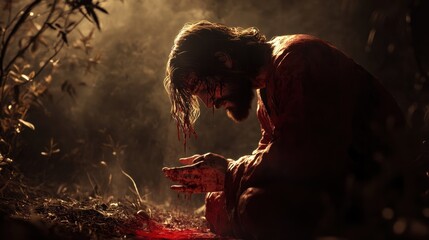
In the heady early days when Jesus walked the earth, there were followers who thought he had come to put an end to the suffering they endured under the tight grip of Roman occupation. It all appeared to go very wrong; Jesus himself suffered the most horrible torture and then a slow and public death. Before his death, when he prayed alone in the garden of Gethsemane, the Gospel of Luke describes how Jesus was in a state of such agony he seemed to sweat blood. Luke records, ”And being in agony he prayed more earnestly; and his sweat became like great drops of blood falling down to the ground’. Maybe it is just simile, but offering still a profound sense that Jesus, fully human as well as fully divine, truly suffered. God himself suffered. So why would we expect otherwise?
Christianity is the one religion where God himself suffers – how can it shy away from the reality of pain and injustice? It can’t and it doesn’t. Instead it makes it a central tenet of the faith. And never more so that in the season in which we now sit liturgically: Passiontide and Holy Week. Passiontide began last Sunday, the 22nd of March and the 5th Sunday of Lent. It takes in the two weeks leading up to Easter itself. It asks us to reflect on the suffering of Jesus as he turns his face to Jerusalem and to the cross. The Greek word for passion is pathos, which means to suffer. As you walk through the story of faith recorded in Scripture, you see suffering everywhere, from Joseph, to Daniel, to Job, to Ruth, to Mary watching her son die, to Paul and the disciples each facing martyrdom in the most grotesque ways – beheading, upside down crucifixion, burning, stoning, and on it goes. In the time of Nero Christians were fed to the lions, and some were used as human torches to light the city for the mad Emperor. Christians do not avoid suffering or under-estimate it. Christians break too. Then and now.
I’m reminded of those words from the Prophet Isaiah, read on Good Friday in churches everywhere. Jesus is describe by him as ‘a man of suffering and acquainted with infirmity, and as one from whom others hide their faces, he was despised, and we held him of no account’.
How lonely that sounds. Adding to the physical trauma of crucifixion, will come the sense of abandonment by God, by his friends, by everyone. Loneliness adds a great deal to any kind of suffering.
Anyone of us might at some time, in the silence of our own hearts, or sometimes out loud late at night, in the dark, have wondered where God is, not whether God is, though many do, but where God is. We might ask why he does not, as it seems to our fallible human logic, use his power, his infinite power, to end pain.

We won’t ask the question in the mocking way of the chief priests in Mark or the soldiers in Luke, or the thief, – all saying roughly the same thing, if you are for real, put an end to this suffering for yourself, for others. For me.
We might ask for God to show himself not as a test, but because the need to feel, to see, to touch is part of what makes us human. There is a good reason why the Church holds to the sacraments, tangible symbols of infinite but intangible grace.
And, when the long night has passed and with it the desperation, and the day comes, some of us might still make what we think are some reasonable requests of God. I’m ok now, for now, but what about others? At least let good people stop hurting, or let children be protected, or, don’t let that irrational madness which is the US continue still? Or, with Job, at least help us to make some sense of some of it, if not all of it. And maybe, if we don’t hear an answer, the answer we need to hear, we might know God is good but still wish him closer. Why has he left me here alone to endure this? What have I done to deserve this?
These are all questions we might ask of God.
Because suffering, whatever form it takes, physical, emotional, spiritual, is lonely. Very lonely.
We forget perhaps. We might forget, in the moment, in the white heat of pain, that he sent us this one tremendous grace-filled sign for all time. The ultimate sign, the Word itself, Jesus Christ, to die on the Cross.
Good Friday tells us exactly where God is when we suffer, when we cause others to suffer. Whether we speak of deserved suffering, if there is such a thing, or undeserved suffering, the suffering we are caused, the suffering we cause others, still we only look at the Cross and we know where God is. All of God is concentrated there in the person of Jesus on the Cross. Taking it all upon himself. Any discussion of how pain and suffering fit into God’s scheme ultimately leads back to the cross.
But Good Friday is not the end. My favourite book throughout my childhood was The Lion, the Witch and The Wardrobe, a Christian allegory written by C S Lewis. My favourite bit of the book comes after Aslan willingly sacrifices himself on the stone altar to appease the deep magic that says a life must be given for the treachery of Edmund. He is shorn and humiliated. But it is not the end. The table cracks and Aslan is restored in all his strength and splendour. The wicked witch who engineered the death of innocence did not know the whole story – that there is a deeper truth than death, and ‘ that when a willing victim who has committed no wrong, offers himself in a traitor’s stead, the stone table will crack and death itself will go backwards‘.
Easter always follows Good Friday, and always will.


Thank you for reading – I look forward to hearing your thoughts!